

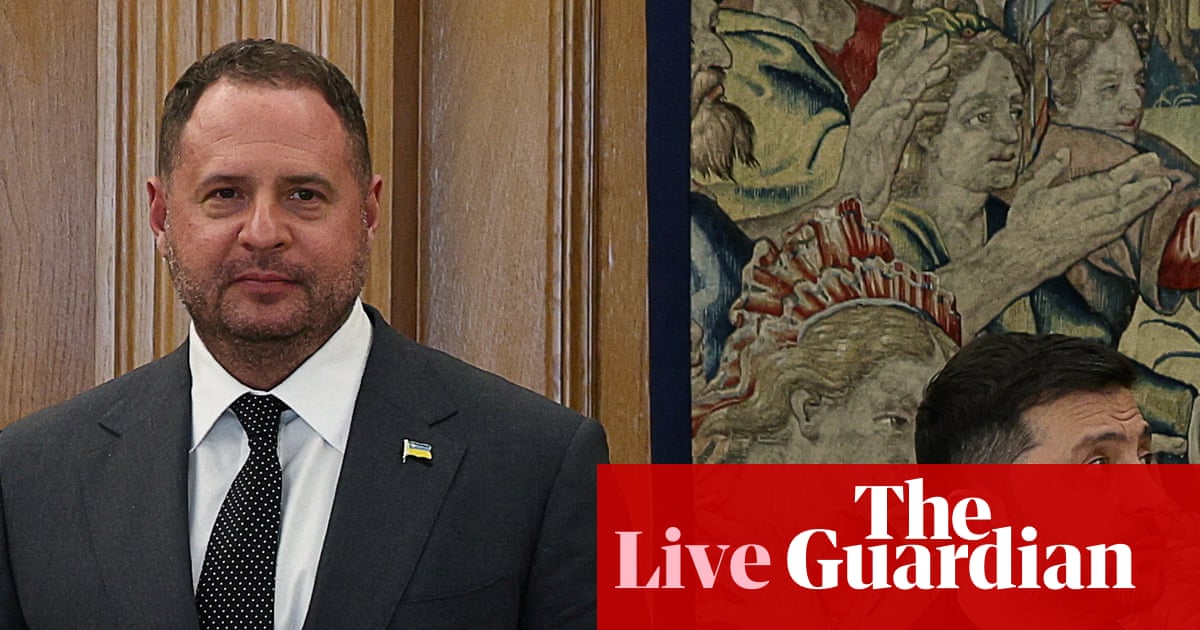
Putin praises Orbán’s ‘balanced’ position on Ukraine as they discussed energy deliveries
Meanwhile, Hungary’s Orbán has met with Russia’s Putin in Moscow in another show of close relations between the two leaders and countries and much to the frustration of the EU.
Welcoming him to the Kremlin, Putin praised Orbán’s “balanced” position on Ukraine, after Hungary repeatedly tried to block further sanctions on Russia.
He also said he would still be happy for his next summit with the US president, Donald Trump, to take place in the Hungarian capital, Budapest, as briefly discussed in October.
For his part, Orbán insisted that Russia remained part of “Hungary’s energy supply now and will remain so in the future,” once again despite EU’s plans to phase out this source.
Key events
Commission ‘trying to make sure concerns … are addressed’ on use of frozen Russian assets
For what it’s worth, the European Commission’s spokesperson Paula Pinho confirmed the commission received de Wever’s letter at her press briefing earlier today.
She said the commission was finalising its proposal, and has consulted extensively with its in-house legal teams.
“We have a very solid, excellent team of lawyers in the Commission, as you know, who has given many … examples of its excellence. So we are fully confident [about] our teams of lawyers who are part of the commission staff,” she said.
She added:
“What we are trying to do is to really make sure that the concerns that have been expressed and notably by Belgium and the prime minister are addressed in a satisfactory manner, so that everybody is comfortable with the positions that are being put forward by the commission.”
Belgium hits back at calls to use Russia’s frozen assets to fund Ukraine

Jennifer Rankin
in Brussels
Meanwhile, Belgium has hit back against an EU plan to use Russia’s frozen assets to aid Ukraine, describing the scheme as “fundamentally wrong” and throwing into doubt how Europe will fund Kyiv.
In a sharply worded letter Belgium’s prime minister, Bart De Wever, said the proposal violated international law and would instigate uncertainty and fear in financial markets, damaging the euro currency. “These risks are unfortunately not academic but real,” he wrote to European Commission president Ursula von der Leyen.
As well as “systemic risks for the EU as a financial marketplace” De Wever warns about Euroclear being sued by Russians with a claim on the assets, landing the Belgian government with the multi-billion euro bill.
He insists he will not sign off on the scheme unless all Belgium’s concerns are addressed including “a full guarantee to be provided by willing member states” if the loan goes wrong, according to the letter seen by the Guardian, which was first reported by Politico.
The Flemish nationalist leader also argues that moving forward with the reparations loan plan would prevent the EU from reaching a peace deal, because the Russian assets would not be available for the reconstruction of Ukraine.
Belgium hosts €183bn of Russian assets, around two thirds of Russian assets immobilised in the west, at the Brussels-based central securities depository Euroclear.
The intervention comes amid growing pressure on the EU to agree the use of Russia’s frozen assets to aid Ukraine, after a US-led plan to end the war called into question Europe’s control of the funds.
The commission is expected to imminently present a draft legal text on using Russian assets immobilised in Europe as the basis for a €140bn (£122bn) loan for Ukraine.
Putin praises Orbán’s ‘balanced’ position on Ukraine as they discussed energy deliveries
Meanwhile, Hungary’s Orbán has met with Russia’s Putin in Moscow in another show of close relations between the two leaders and countries and much to the frustration of the EU.
Welcoming him to the Kremlin, Putin praised Orbán’s “balanced” position on Ukraine, after Hungary repeatedly tried to block further sanctions on Russia.
He also said he would still be happy for his next summit with the US president, Donald Trump, to take place in the Hungarian capital, Budapest, as briefly discussed in October.
For his part, Orbán insisted that Russia remained part of “Hungary’s energy supply now and will remain so in the future,” once again despite EU’s plans to phase out this source.
The Commission also totally rejected dismissed Russia’s criticism of Volodymyr Zelenskyy as “illegitimate” leader of Ukraine, after Vladimir Putin suggested yesterday that was a technical reason he couldn’t agree a peace deal with Zelenskyy.
“President Zelensky is the democratically elected president, by the Ukrainian people, of Ukraine,” a commission spokesperson said in response, somewhat mockingly adding that Putin seems to have “some difficulties in recognising the democratically elected president of his neighbour country, Ukraine.”
EU will ‘follow situation very closely,’ but searches show anti-graft agencies are working
The European Commission has very cautiously responded to the reports coming from Kyiv at its daily midday briefing.
EU chief spokesperson Paula Pinho noted the searches, stressing they were “ongoing” and said that these actions “show that the anti-corruption bodies in Ukraine are doing their work.”
Enlargement spokesperson Guillaume Mercier followed the same line, saying that the probe “showed precisely that the anti-corruption bodies are actually in place and they’re allowed to function.”
He added:
“Let me stress the fight against corruption is a key element for a country to join the EU, it requires continuous efforts and a strong capacity to fight corruption. This is a key element that we also address in our enlargement report that was published a couple of weeks ago, so we will continue to follow the situation very closely.”
Ukraine’s anti-corruption agencies search home of Zelenskyy’s chief aide — first story

Dan Sabbagh
in Kyiv
Ukraine’s anti-corruption agencies have said they are conducting searches at the home of Volodymyr Zelenskyy’s powerful chief aide and lead negotiator in the latest round of peace talks, Andriy Yermak.
Journalists filmed about 10 investigators entering Kyiv’s government quarter in a widening of the investigation into a nuclear energy kickback scandal allegedly run by an associate of the Ukrainian president who has fled the country.
The scandal first emerged earlier in November, but after days of damaging revelations, it dropped down the news agenda when Donald Trump unexpectedly released a pro-Russian 28-point peace plan.
But Friday’s developments will thrust the scandal back into the spotlight just as Ukraine had been carefully wooing the White House on a 19-point counterproposal, with Yermak fronting talks in Geneva with the US secretary of state, Marco Rubio.
Zelenskyy himself has denounced the scheme. However, questions have been raised about how much senior figures in government knew about what was happening, given how many have been accused of involvement.

Jakub Krupa
And let’s go back to Dan Sabbagh in Kyiv for his first story on this morning’s news.
Political analyst Viktor Shlinchak, of the Kyiv-based Institute for World Politics, described the searches as a “Black Friday” for Yermak and suggested Zelenskyy may be forced to dismiss him.
“It looks like we may soon have a different head of the negotiating team,” he wrote in a Facebook post, quoted by Reuters.
‘Everyone will be watching this very closely’ — snap reaction
Dan Sabbagh
in Kyiv
Hello Jakub, it’s Dan Sabbagh just walking down the streets in Kyiv.
What to say about this extraordinary news? It’s clearly very significant that Andryi Yermak’s apartment in the government district in the heart of Kyiv has been searched by officers from Ukraine’s powerful NABU anti-corruption agency.
But the question is, what will happen next? It certainly, on the face of it, looks like a widening of the corruption investigation relating to allegations of kickbacks demanded of contractors of the state nuclear energy company, Energoatom.
But of course we don’t know what the outcome of these searches will be and it may well be that the corruption investigators will conclude there’s nothing to see here. So the situation is balanced.
Everyone in Ukraine will be following developments closely. There’s a lot of anger, of course, because of this moment in the war as most Ukrainians in Kyiv, for example, are enduring power outages many hours a day because of the Russian bombing. And so the whole allegation of kickbacks in the most important electricity company, nuclear energy being the most important, it’s a very serious one.
But for now, the outcome is unclear. Andriy Yermak is President Zelenskyy’s most important aide, the head of his office, inseparable from him since the early days of the invasion and indeed throughout.
Zelensky has always stood by Yermak, and there’s no immediate sign of that changing, but everyone will be watching very closely.
Yermak’s property search will have huge repercussions for Ukraine and potentially peace talks — snap reaction

Shaun Walker
The revelations that anti-corruption police are searching the property of Volodymyr Zelenskyy’s chief of staff Andriy Yermak will have huge repercussions for the Ukrainian political scene and possibly for peace negotiations as well.
It is hard to overstate the significance of Yermak in the Ukrainian political system.
He combines multiple roles for Zelenskyy: most trusted sounding board, domestic political enforcer, controller of access to the president, main point of contact for foreign politicians and chief peace negotiator.
Yermak is such a powerful chief of staff that people who know how the president’s office operates describe his relationship with Zelenskyy as symbiotic.
Those who have dealt with Yermak, both inside and outside Ukraine, describe him as a workaholic and a ruthless operator, who has moved against alternative centres of political influence in the country and has systematically worked to acquire political power.
With such influence inevitably comes enemies, and there are few in the Ukrainian elite who have a positive view of Yermak, though many admire his work ethic and political skills.
Foreign politicians have often appreciated knowing they can use Yermak as a direct line to the president, but some have found him a frustrating interlocutor, and figures in the Trump White House are known to have expressed a preference for dealing with Rustem Umerov, the current head of Ukraine’s security council, over Yermak.
Up to now, Zelenskyy has always resisted calls to fire Yermak or even clip his wings, but if he is now caught up in a corruption scandal, these are likely to get louder. Politically, getting rid of his chief of staff might be Zelenskyy’s smartest move, but those who know both men say the relationship is so close it’s hard to imagine Zelenskyy taking that step.
“I suppose it’s theoretically possible that Zelenskyy could function without him but in practice I can’t imagine that ever happening,” one former senior official told me a couple of months ago.
Hungary’s Orbán expected to visit Putin for talks on energy, Ukraine
Another big story happening today is Hungarian prime minister Viktor Orbán’s unexpected visit to Moscow, where he is due for talks with Russia’s Vladimir Putin on energy supplies and ending the Ukraine war.
“I am going there to ensure that Hungary’s energy supply is secured for the winter and the following year at an affordable price,” Orbán said in a video uploaded to Facebook.
Hungary has been Russia’s closest ally in the EU, repeatedly criticising the bloc’s response to the Russian aggression on Ukraine, calling for more engagement with Moscow and for sanctions to be lifted.
AFP noted that since returning to power in 2010, Orbán has met Putin 15 times, including four times since the full-scale invasion in 2022.
The Hungarian prime minister is facing a tricky parliamentary election early next year, with his Fidesz party trailing behind the pro-EU opposition forces in the polls, which may explain why he is looking for successes wherever he can find it.
If you’re wondering how serious for Ukraine and Zelenskyy this could get, let’s just say that Yermak has overnight literally fronted Ukraine’s response to the latest peace talks, with an interview in The Atlantic magazine in the US.
Characterised as “Zelenskyy’s chief of staff, lead negotiator and closest aid throughout the full-scale war with Russia,” Yermak insisted that “not a single sane person today would sign a document to give up territory.”
“As long as Zelensky is president, no one should count on us giving up territory. He will not sign away territory,” he told the magazine by telephone from Kyiv.
He was also directly involved in the talks in Geneva over the weekend.
Morning opening: Zelenskyy’s number two sees apartment searched as part of anti-graft probe
Jakub Krupa
Ukrainian anti-corruption authorities are searching properties linked to president Volodymyr Zelenskyy’s powerful chief of staff Andriy Yermak.
In a post on Telegram, Yermak confirmed the authorities were given “full access” to his apartment, and that he is cooperating with the officers, with his lawyers present.
In a joint statement, the National Anti-Corruption Bureau of Ukraine and the Specialised Anti-Corruption Prosecutor’s Office said the searches were “authorised” and linked to an unspecified investigation.
“NABU and SAPO are conducting investigative actions (searches) at the head of the Office of the President of Ukraine,” they said. “Investigative actions are authorised and are being carried out within the framework of an investigation.”
It was not immediately clear what was the investigation about.
Reuters noted that erlier this month, the two agencies unveiled a sweeping investigation into an alleged $100m kickback scheme at the stage atomic energy company, involving Zelenskyy’s ex-business partner.
While Yermak has not been named a suspect in the investigation, but opposition lawmakers and some members of Zelenskyy’s own party had called for his dismissal as part of Ukraine’s worst wartime political crisis, the agency said.
Earlier this year, Ukraine had been engulfed in a political crisis over Zelenskyy’s controversial plans to reform the anti-corruption authorites, which ultimately had to be reversed after intense international criticism, including from the European Union, which continues to say that the fight against corruption remains one of Ukraine’s key task on its path to join the bloc.
The searches come at a tricky time for Ukraine amid growing pressure from the US to agree to a peace deal with Russia, and any perceived or real sense of wrongdoings at the top of the government could undermine Ukraine’s position further.
This could be explosive.
I will bring you all the key updates throughout the day.
It’s Friday, 28 November 2025, it’s Jakub Krupa here, and this is Europe Live.
Good morning.
