


Changing the FDA’s Vaccine Approval Process Could Threaten COVID, Flu Protection for Children
The FDA is reportedly mulling changes that could make childhood vaccines less accessible and more expensive
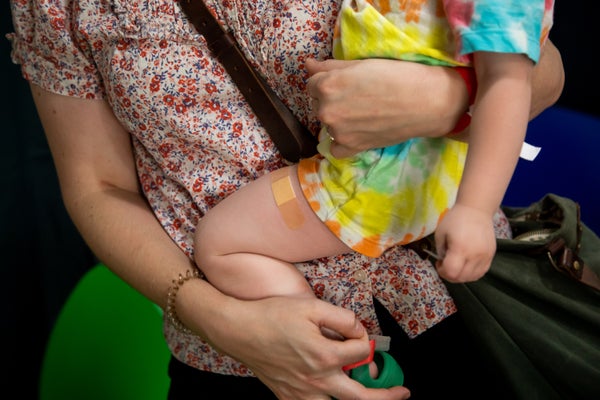
Michael Nagle/Bloomberg via Getty Images
The U.S. Food and Drug Administration plans to change how COVID vaccines and other shots are approved and administered.
In a memo obtained by the New York Times and other outlets, a top FDA official directly linked the deaths of 10 children to COVID vaccines but included scant details about the cases, including the specific vaccine in question or how the FDA came to its conclusions.
The memo, which was written by FDA chief medical and scientific officer Vinay Prasad and apparently leaked days before a key vaccine advisory panel is set to meet, outlines several proposals to change the way vaccines are tested and approved in the U.S. that experts said are not based in science.
On supporting science journalism
If you’re enjoying this article, consider supporting our award-winning journalism by subscribing. By purchasing a subscription you are helping to ensure the future of impactful stories about the discoveries and ideas shaping our world today.
The proposals include requiring vaccine makers to study new shots in all subgroups (including pregnant people), changing how the annual flu shot is approved and reconsidering whether the flu and COVID shots can be gotten together. Collectively, the changes would require vaccine makers to show far more data on safety and efficacy, driving up costs and ultimately making childhood vaccinations less accessible, experts say.
“It means that every vaccine that could save us from going into the hospital with one of these respiratory viruses will now be delayed,” says Sallie Permar, chair of pediatrics at Weill Cornell Medicine.
And spreading out vaccines rather than giving them at the same time would create “a lot of complexity and confusion and isn’t really based on the science of immunology,” she adds.
COVID vaccines have been extensively tested for safety. As with any vaccine, there are potential risks, which regulators weigh against the benefits in protecting against disease. In the case of the COVID shots, scientists identified rare cases of heart inflammation, or myocarditis, in some boys and young men who received mRNA COVID vaccines. But these cases generally resolved without treatment, and COVID and other infections can also trigger the condition.
“The COVID vaccine, and mRNA vaccines in general, remain one of the safest vaccine platforms that we’ve ever seen developed,” Permar says.
In the memo, the FDA calls for stricter requirements for approving vaccines for pregnant women, the Washington Post reported, a move that could affect both expectant parents and young babies.
Pregnant people have a higher risk of severe disease and death from COVID, so making it harder for them to get vaccinated would jeopardize their health and that of their fetus, Permar says. The same is true for flu, which is why doctors recommend that all pregnant people get a flu shot.
Young babies are also among the highest-risk groups because they have little to no immunity to the disease, Permar says. Maternal vaccination or infection protects babies under six months of age, but after that point, their immunity starts to wane. The COVID vaccines were approved for children six months and older as a way to provide continuing protection.
The memo also reportedly called for re-examining how the annual flu shot is approved. Scientists have decades of evidence to show that the flu vaccine is safe and effective at keeping people out of the hospital, even if it doesn’t prevent them from getting sick, Permar says. Every year the flu virus evolves, so the vaccine is tweaked slightly to match circulating strains. These seasonal variations are not typically tested in a full-blown clinical trial, but under the FDA’s proposal, that could change—costing vaccine makers much more money and time.
The FDA is also reportedly reconsidering whether COVID and flu shots should be given together. Trump administration secretary of health and human services Robert F. Kennedy, Jr.—and President Donald Trump himself—have previously suggested that childhood vaccines should be more spaced out. Evidence does not support this. Combination vaccines such as the measles, mumps and rubella (MMR) vaccine have been shown to be as safe and effective, or more so, than giving children the shots individually. Spacing them out would only require parents to make more trips to the pediatrician, leading to lower uptake, Permar says.
“What parents and families want right now is to have decreased complexity in their lives,” she says.
It’s Time to Stand Up for Science
If you enjoyed this article, I’d like to ask for your support. Scientific American has served as an advocate for science and industry for 180 years, and right now may be the most critical moment in that two-century history.
I’ve been a Scientific American subscriber since I was 12 years old, and it helped shape the way I look at the world. SciAm always educates and delights me, and inspires a sense of awe for our vast, beautiful universe. I hope it does that for you, too.
If you subscribe to Scientific American, you help ensure that our coverage is centered on meaningful research and discovery; that we have the resources to report on the decisions that threaten labs across the U.S.; and that we support both budding and working scientists at a time when the value of science itself too often goes unrecognized.
In return, you get essential news, captivating podcasts, brilliant infographics, can’t-miss newsletters, must-watch videos, challenging games, and the science world’s best writing and reporting. You can even gift someone a subscription.
There has never been a more important time for us to stand up and show why science matters. I hope you’ll support us in that mission.
