

Key events
Sarah Basford Canales
Burke was also asked whether the Albanese government’s decision in 2022 to move Asio and the Australian Federal Police from the home affairs department to the attorney general’s department – a decision reversed this year – had hampered intelligence.
The minister said it was his decision to return the agencies to home affairs to assist with “seamless” information-sharing.
Burke added they both had enough resources to monitor both politically-motivated and religiously-motivated extremism: “I’ve confirmed with the Australian Federal Police and with Asio again in the last 24 hours that they both have more resources than they have ever had, and believe they get a fair hearing whenever they put a resources case to government.”
Asio’s director-general, Mike Burgess, drew comparisons between Islamist political group, Hizb ut Tahrir, and the neo-Nazi group, the National Socialist Network, warning their “anti-Israel rhetoric is fuelling and normalising wider antisemitic narratives”.
“The organisation’s condemnation of Israel and Jews attracts media attention and aids recruitment, but it deliberately stops short of promoting onshore acts of politically motivated violence,” Burgess said.
The UK banned Hizb ut Tahrir from recruiting or holding protests and meetings in 2024, joining countries like Germany and Indonesia.
Burke said he would list the group once it met the threshold, which he said it had yet to.
“My view for a very long time has been, and as soon as I came into home affairs, I asked again. I’ve continued to ask, ‘do they meet the legal threshold?’ Because the moment they meet a legal threshold, I see them causing nothing but harm in the community,” he said.
Sarah Basford Canales
Home affairs minister says he has ‘full confidence’ in Australia’s intelligence agency
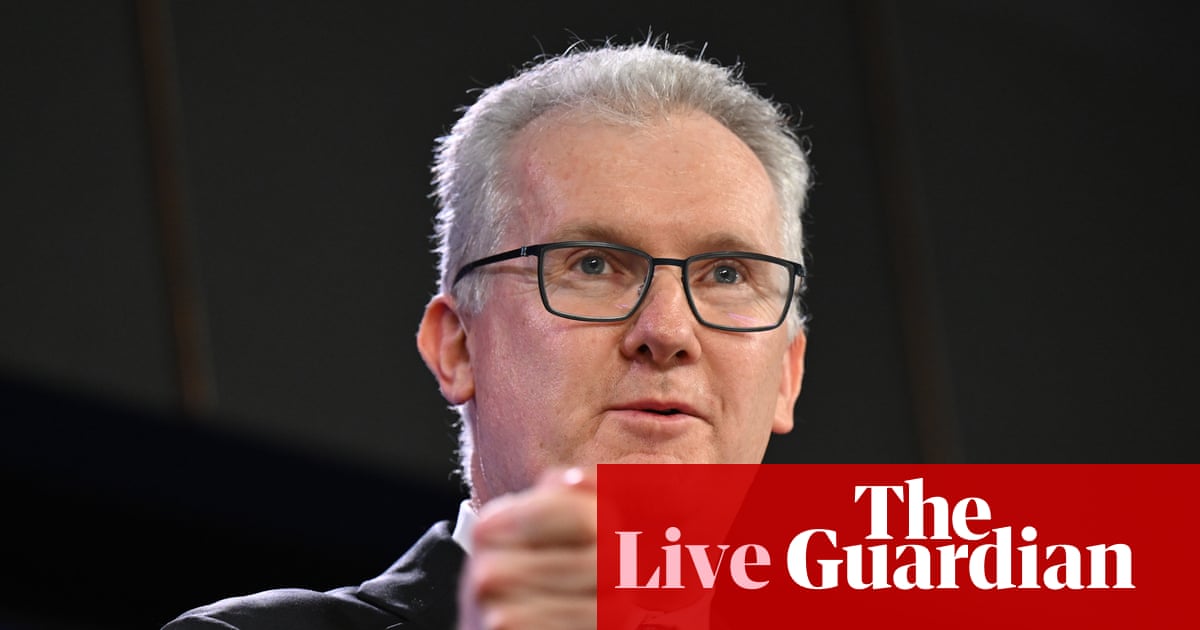
Tony Burke maintains he has “full confidence” in Australia’s domestic intelligence agency as questions are raised about how the father and son duo allegedly behind the Bondi attack, and inspired by Islamic State, were able to travel to the Philippines last month without raising flags.
The home affairs minister said he had reviewed the Australian Security and Intelligence Organisation’s (Asio) decisions and actions regarding 24-year-old Naveed Akram – who was charged with 59 offences including 15 counts of murder on Wednesday – since he first came to attention in October 2019 for alleged associations with individuals involved in a reported Islamic State cell.
“I’ve gone through the different decisions that have been taken in this respect, and I have confidence of the decisions that [were] made,” Burke told ABC’s 7.30 on Wednesday.
“Obviously, they are not all decisions that were made during the life of this particular government, but I’m not playing political games with any of this. And no matter who was in office at different times, I have confidence in the way decisions were taken.”
Authorities in the Philippines confirmed on Tuesday that Akram and his 50-year-old father, Sajid, who was shot dead by police on Sunday, travelled to the south-east Asian country between 1 November and 28 November. They listed Davao, in the country’s south, as their final destination in the Philippines.
Davao is the capital of the southern Philippine island of Mindanao. The island’s more remote regions, west of Davao, have been a centre of resistance for the country’s pro-Islamic State and Islamist militant groups.
Burke said he could not publicly reveal whether Asio continued to monitor Akram after the six-month examination six years ago, or whether the duo’s trip to the Philippines in November triggered a movement alert list.
“I can just answer it in the general, that is, the movement alert list is very vast, and when people come to our attention, they generally stay there for a very, very long time,” he said.
Welcome
Good morning and welcome to our live news blog. I’m Martin Farrer with the top overnight stories before our morning blogger takes the reins.
The home affairs minister, Tony Burke, insists he has “full confidence” in Asio and its decisions despite the intelligence agency apparently missing the rising threat posed by the alleged Bondi gunmen. More on that soon.
Last night the prime minister, Anthony Albanese, called for unity at a multifaith event in Sydney, after a day in which he faced intense criticism over his response to antisemitism in Australia.
And Israel’s prime minister, Benjamin Netanyahu, has added fuel to that criticism with another attack on the Australian government overnight. We bring you more on this, too, in a few minutes.
