

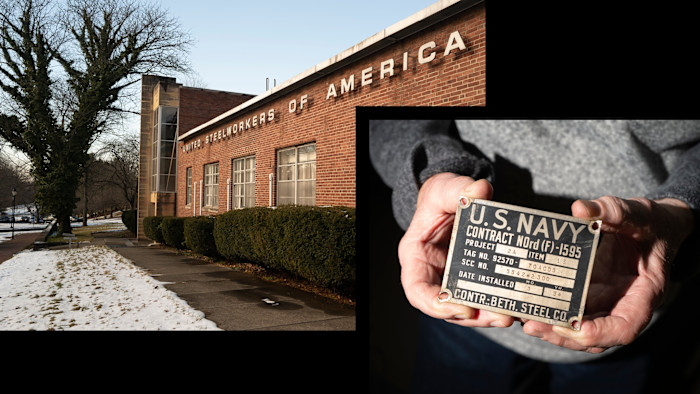
On a crisp December afternoon, a small group of ageing trade unionists met under fluorescent lights in the headquarters of United Steelworkers Local 2599, a room that has outlived the local industry it once served.
The meeting was almost ceremonial, but it unfolded against a backdrop of political and economic upheaval that has shaped the national mood under US President Donald Trump.
The two dozen men and women were gathered in the low brick building in Bethlehem, Pennsylvania, for a monthly meeting and lunch of the Steelworkers Organization of Active Retirees.
They collected fees in an old coffee can, pledged allegiance to the flag, and observed a moment of silence for dead members: choreography from an older industrial order, long after the collapse of its economic foundations.
These are the alumni of Bethlehem Steel, once among America’s most important corporations, employing tens of thousands of people and with its own police force and railroad. Its product girded America’s monuments and helped the US and allies win two world wars.
It is more than three decades since the company produced any metal in Bethlehem. But the Steel, as the men still call it, was as much a governing entity in this region as an employer, shaping work, politics and identity.

“You worked in one department for 30 years and we were like family,” said Mike Dzwonczyk, the Soar treasurer.
After decades in the blast furnace, Dzwonczyk drove trucks part time and talks wistfully of the years when he would sink beers with colleagues, when the Lehigh Valley was “a pretty lively place”.
Bethlehem Steel’s mass of buildings, many rusted, still stretches for miles along the Lehigh river. But the plant’s demise defines a region, as new industries — from health to education — emerge in an area of eastern Pennsylvania that was once a byword for American industrial power.
The greater Bethlehem area, where the Financial Times is reporting over the coming years to offer a lens on Trump’s America, has lost about a third of its manufacturing jobs since 1990, according to the Bureau of Labor Statistics.
The erosion mirrors a national transformation that has injected political volatility into rustbelt regions and left voters sceptical of Washington and the economic establishment.
Trump, who rode this discontent on his way back to the White House in 2024, says his tariffs on foreign steel producers can make areas such as the Lehigh Valley industrial again.
“Other steel companies are coming to Pennsylvania now because they don’t want to spend 100, 50 per cent, 25 per cent on tariffs, they’re all coming in. It’s amazing,” the president said on a visit to Mount Pocono, 40 miles up the road from Bethlehem, in mid-December.
“I know what it’s like to build something with my hands,” said vice-president JD Vance a few days later on a visit to the Lehigh Valley. “The future of this country won’t be forged in the halls of these woke universities. It’ll be at the hands of the skilled worker.”
The cost of years of real physical labour was written in the stooped postures of Soar men in Bethlehem. Coke gas and asbestos exposure had left some with cancers.
They were riggers, carpenters, electricians, veterans of the beam yards, the steam air and water division and the blast furnaces.
Plus one outlier. “He worked in management, so he don’t count,” one person joked, conducting a census of the room.
The humour hinted at the kind of class consciousness that once made the Democratic party an anchor in steel towns such as Bethlehem. That erosion has also scrambled some of the politics.
Some of the men had seen the changes over decades at close hand.
Tom Sedor, Soar’s vice-president, was descended from three generations of Bethlehem steelworkers on both sides of his family. The biography of the 84-year-old former electrician tracked the arc of industrial America.
As Bethlehem Steel operations seized up in the 1990s, he was among the workers who sought jobs locally in other industries or steelwork elsewhere to qualify for pensions.
On the way home from lunch, Sedor drove past the Steel. It was festooned with holiday lights while harried parking attendants shepherded a horde of market-goers.
“I get a little nervous around that one,” Sedor said, pointing out a rusting furnace in the dusk light. “That’s where my father was killed. But I do like it better at Christmastime.”


The former steelworks now hosts concerts and festivals, while a museum recounts the industrial history.
Shortly after the second world war, a blast furnace exploded here, killing six men and badly burning Sedor’s father, John, with molten metal.
Tom was nine years old, too young to go inside the hospital. He was walking with his mother when a man ran out of a house towards them. “I know who you are,” he told Sedor. He showed Tom his hands. They were burnt. He had worked to rescue his father.
Sedor’s father later died of a blood clot related to his injuries, one of 856 workers who have died as a result of their work at the company, according to a memorial pamphlet handed out in the union hall.
After a spell in the Navy, Sedor followed his father and in 1964 began working at Bethlehem Steel.
“When my father died I was on my own,” Sedor recalls. “You’re driven.”
He now lives in the quiet nearby borough of Northampton. The route to his house passes by industrial buildings that have become apartment blocks, self-storage units, restaurants and art galleries.
Sedor pointed at the houses on his street. “Teacher, professor, Mack Trucks worker, airline pilot, stockbroker, policeman,” he said, recounting his neighbours’ jobs. His daughter, a dental hygienist, lives two blocks away. His son, a narcotics investigator, lives next door.
The politics have changed too — another outcome of economic industrial decline and the retreat of unionised labour.
“You couldn’t even speak about Republicans, and if there were any they were in the closet,” Sedor said of the union’s heyday. “When the plant shut down, they came out of the closet.”
The area, like the country, is now cleaved along electoral divides. While Lehigh county, which contains some of Bethlehem, voted narrowly for Kamala Harris in 2024, Northampton county, which contains the rest, voted for Trump.


Perhaps the president’s ambition to reindustrialise was good, Sedor said, but he doubted his approach could work. “Tariffs on bananas? We don’t even make bananas here,” he said.
Sedor sat at his kitchen table, where he had placed a framed certificate awarded to his grandfather, Frank Rau, certifying his completion in 1906 of an apprenticeship in Machine Shop No 2.
Rau helped raise Sedor after his father died and is a mythic figure in this home — he once swam across the river Lehigh under cover of night, they say, broke into a Bethlehem Steel office and destroyed a blacklist of union men.
Sedor reflected on his own life in the steelworks — memories from an era now fought over by politicians invoking America’s industrial past.
“It was like having 12 fathers,” he said. “Half of them were assholes, and half of them were nice guys. I’d do anything for them.”
The new industries emerging in Pennsylvania lacked that sense, he suggested: bitcoin miners, burning waste coal and shredded tyres for power; and data centres moving into old industrial sites.
As he spoke to the FT, Sedor’s granddaughter wandered into the kitchen. She was planning to study nursing. Healthcare and education are now leading industries in the Bethlehem area — another trend replicated nationwide, where the sectors’ share of employment has almost doubled since 1990, to 17 per cent.
Sedor lumbered down the stairs to his cold and crowded basement. A portrait of John F Kennedy hung on the wall. On many of the objects stored here, Sedor had affixed makeshift price tags, informed by eBay research. Vintage motor oil jar: $50. Fishing creel: $80. Roseville pottery: $150. This was less about profit, it seemed, and more about putting value on the past.
His most precious items were unlabelled. Sedor pointed proudly at a piece of the last steel beam ever produced in Bethlehem signed by the chief metallurgist, his original Bethlehem Steel credential card, and a photograph of him and his colleagues in the electrical repair shop, gathered around a motor, tired and smiling.
