

Good morning and welcome back. In today’s newsletter:
-
Donald Trump drops tariff threat over Greenland
-
European governments turn to short-term debt
-
SocGen to axe 1,800 jobs in France
-
A Gen Zer’s year without a smartphone
We begin in Davos, where US President Donald Trump said he was dropping his threat to hit European countries with new tariffs after striking a “framework of a future deal” over Greenland in talks with Nato secretary-general Mark Rutte.
What to know: The US president said he had held a “very productive” meeting with Rutte and would have future talks and find a solution that, “if consummated”, would be a “great one” for the US and Nato members.
In a later interview with CNBC, Trump said he had backed down from his plan to impose duties on European countries opposed to a US takeover of Greenland because “we had pretty much the concept of a deal”. He added that the framework agreement could involve Greenland’s natural resources.
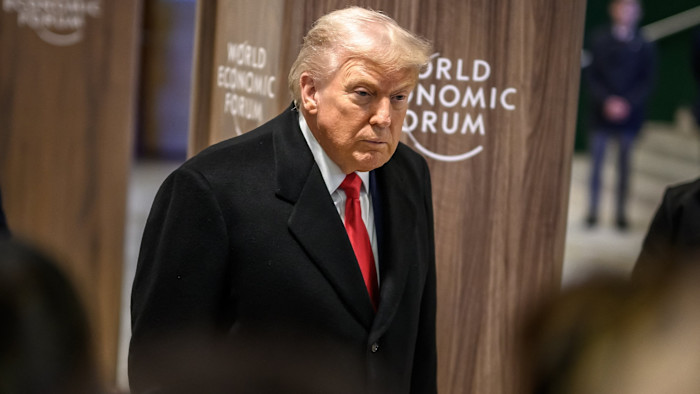
His comments marked another reversal of a tariff threat and a significant softening of his stance on Greenland. They came hours after he told an audience at the World Economic Forum in Davos that he would not use force to acquire the territory from Denmark — but told Europe to back his plan.
Denmark’s foreign minister Lars Løkke Rasmussen has said he welcomes Trump’s decision to rule out taking Greenland by force and pause the trade war but signalled that negotiations will continue.
Market reaction: The withdrawal of the tariff threat offers a sudden reprieve to global markets and will ease fears of a breakdown in the transatlantic relationship. Stocks rallied yesterday after Trump’s U-turn, with the S&P 500 rising 1.2 per cent. Read the full story.
-
Flummoxed: EU leaders from 27 member states convene for an extraordinary summit in Brussels today to discuss how to respond to Trump’s rollback of Greenland threats.
-
Instant Insight: Trump may be climbing down on Greenland but American allies will not forget the episode, writes Gideon Rachman.
-
Trump’s ‘Board of Peace’: A fledgling club of autocrats, strongmen and monarchs is taking shape as the US president tries to recast the global order.
Here’s what else we’re keeping tabs on today:
-
Economic data: The UK reports public-sector finances for December. The US issues updated third-quarter GDP estimate.
-
Results: Capital One, GE Aerospace, Intel, Northern Trust and Procter & Gamble
report earnings. See The Week Ahead for a fuller list.
-
Davos: Speaking at the World Economic Forum are California governor Gavin Newsom, Israeli President Isaac Herzog, German Chancellor Friedrich Merz and Greek Prime Minister Kyriakos Mitsotakis. Trump is expected to meet Ukrainian President Volodymyr Zelenskyy.
Join FT Live all week at Davos for exclusive interviews, high-level briefings, webinars and more alongside the WEF. Register for free.
Five more top stories
1. European governments are curbing their sales of long-term sovereign bonds, as they shift towards shorter-term funding to limit the damage from a rise in borrowing costs. The average maturity of debt sold across big Eurozone markets is expected to dip below 10 years for the first time since 2015 this year.
2. Société Générale is planning to axe 1,800 jobs in France by the end of 2027, a union has said. Chief executive Slawomir Krupa is pressing ahead with a turnaround that has focused on strengthening the lender’s capital position and reducing costs.
3. Exclusive: Carmakers have refused to back an effort by the EU’s industry commissioner to rally support from leading sectors on its plan to prioritise “made in Europe” products, highlighting deep divisions over how to fight back against an influx of affordable Chinese vehicles.
4. Exclusive: Phoenix Group, Royal London and Scottish Widows are among those circling the £2bn UK insurance business of Dutch insurer Aegon. As well as potential strategic buyers, private equity groups such as CVC have also shown preliminary interest in the sales process.
5. South East Water, the UK utility hit by weeks of outages that left tens of thousands of customers without water, has paid almost as much in interest and dividends in the past 15 years as it has invested in its infrastructure. Read the full report.
Correction: Yesterday’s FirstFT incorrectly attributed comments from Nestlé’s chief executive to an interview, when they were actually made at an employee event. We are sorry for the error.
The Big Read
Economic uncertainty, cost pressures and the arrival of AI have brought a reduction in entry-level roles, with potentially disastrous consequences for young people and companies. Read more on the great graduate job drought.
We’re also reading and listening to . . .
Map of the day
Trump once told a journalist about his desire to acquire Greenland: “I love maps. And I always said, ‘Look at the size of this. It’s massive, and that should be part of the United States.’” But the Arctic island is not as big as it seems.

Take a break from the news . . .
All Harvey Nriapia ever knew was his iPhone. But after feeling ashamed of his screen time, the FT Gen Zer swapped the device for a flip phone. A year on, he shares what he has learned about life without a smartphone — and whether he will ever go back.

