

An animated 3-D model of the moon, shown on a black background.
A 3-D model of the moon with the near side in view. It reads: This is the side of the moon we see from Earth
In the first era of moon exploration, NASA and the Soviet Union focused on the near side of the moon, where there was direct radio communication with Earth.
A 3-D model of the moon with the near side in view and circles for landing and crash sites, including Luna 9, 1966 (U.S.S.R.) and Apollo 11 and Apollo 12 (both in 1969, U.S.A).
Today, NASA and other space agencies, like those of China and India, are intrigued by the far side of the moon, which is out of view from Earth…
A 3-D model of the moon with the far side in view and circles for landing and crash sites, including Chang’e 4, 2019 (China) and Chang’e 6, 2024 (China).
…as well as the polar regions.
A 3-D model of the moon with the south pole in view and circles for landing and crash sites, including the same Chang’e missions and also Chandrayaan-3, 2023 (India).
A new lunar race is now underway: The United States wants to land humans back on the moon by 2028, two years ahead of China. But the motivations are somewhat different from what put men on its surface 50 years ago.
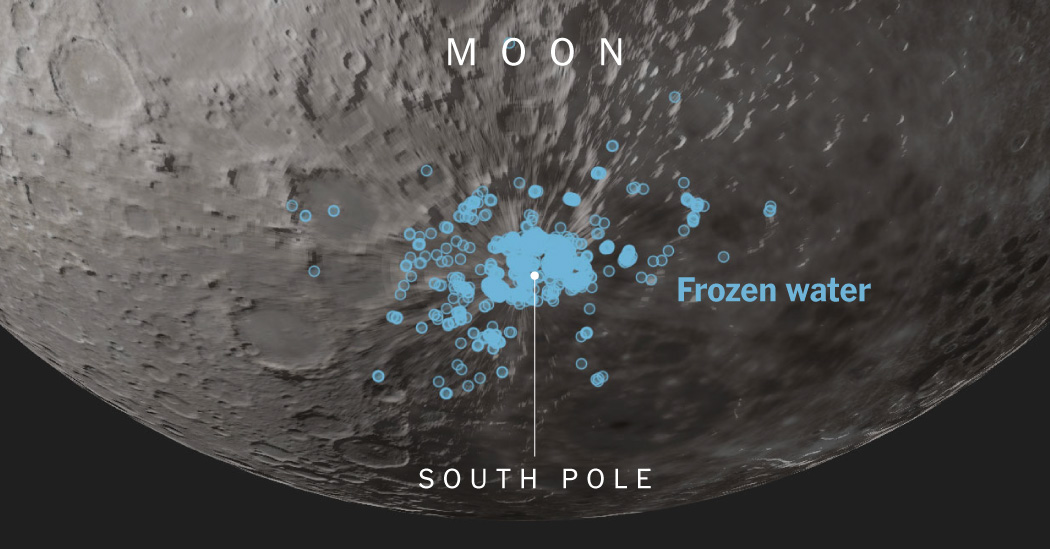
There is water at the moon’s poles, frozen in the eternal shadows within craters.
Water molecules can be broken apart into hydrogen and oxygen. If countries set up moon bases there, the oxygen could provide breathable air, and hydrogen and oxygen could be used as rocket propellants. Astronauts could also get their drinking water from the moon’s ice. NASA has identified potential landing sites in this area, and China wants to build outposts around the moon’s south pole.
For scientists, the water and other chemicals trapped in the shadowed regions could provide a record of comet and asteroid impacts. Cores drilled from the crater floors could provide a history of the solar system stretching back 4.5 billion years, similar to how ice cores extracted from Greenland and Antarctica tell of Earth’s climate over the past few thousand years.
Helium-3 could be mined from the lunar soil.
Helium-3, a lighter version of helium, with only one neutron in its nucleus instead of two, is exceedingly rare on Earth. It costs about $9 million a pound, and the biggest source is decayed tritium, a heavy form of hydrogen found in nuclear weapons stockpiles.
The moon could provide much more. The fusion reactions that light up the sun produce helium-3, some of which is propelled throughout the solar system as part of the solar wind that blows outward from the sun. Some of those atoms slam into the moon and become embedded in the lunar soil.
Titanium-rich minerals are more likely to trap helium-3. The rocks on the near side of the moon contain more of these minerals and those locations are believed to be most promising for the mining of helium-3.
Although concentrations are low, they are still higher than on Earth, whose magnetic field deflects the solar wind around the planet.
Decades in the future, helium-3 could be an ideal fuel for fusion power plants. A more immediate use could be for ultracold refrigerator systems needed for quantum computing.
Animated 3-D model of the moon that shows higher concentrations of helium-3 on the near side of the moon.
A lunar telescope could be installed in a crater on the far side of the moon.
Over the past century, the Earth has become a noisy place for astronomers wishing to listen to the radio waves that fill the universe. Those waves emanate from glowing gas clouds of hydrogen, auroras of distant planets and fast-spinning neutron stars. But those signals are often drowned out by ubiquitous transmissions of modern society like radio and television shows, cellphone calls and industrial electrical equipment.
The Earth’s ionosphere also blocks long-wavelength radio waves, which would give clues about the very early universe, from reaching ground-based radio telescopes. But on the far side of the moon, all that radio noise from Earth is silenced, unable to pass through 2,000 miles of rock. And the long-wavelength radio waves could also be observed.
Building a radio telescope in a crater on the moon would take advantage of that natural concave shape. A location near the equator in the middle of the far side could be an ideal listening spot.
After years of talking about lunar outposts in vague terms for sometime in the indefinite future, NASA recently shifted, putting a continuing U.S. presence on the moon solidly on its road map for the coming decade.
Plans for a moon base would proceed in phases. It would go from regular moon visits to building permanent infrastructure; power and communication systems; vehicles to carry astronauts and cargo across the surface; and possibly nuclear power plants.
Methodology
The 3-D model’s base imagery is from NASA’s Moon CGI kit. Data on lunar landing and crash sites was gathered and verified using multiple sources: NASA Space Science Data Coordinated Archive; China National Space Administration; Japanese Space Agency; European Space Agency; Indian Space Research Organization; and the Smithsonian Institution.
To create the time-lapse animation showing the moon’s permanently shadowed areas at the south pole in January 2026, New York Times journalists used a digital elevation model from the Lunar Orbiter Laser Altimeter (LOLA), data from LOLA’s Gridded Data Records (GDRs) and ephemeris sourced from the U.S. Geological Service (USGS) Astropedia.
Frozen water detections were provided by Shuai Li from the University of Hawaii.
Lunar landing sites for future Artemis missions at the South Pole are from NASA’s update from October 2024.
Helium-3 concentration data was provided by Wenzhe Fa from Peking University, China.
Diagrams of the lunar radio telescope deployment and radio interference are based on NASA Jet Propulsion Laboratory’s concepts.
This project also used geographic references from the USGS Geologic Atlas of the Moon and the Lunar South Pole Atlas by the Lunar and Planetary Institute.
