

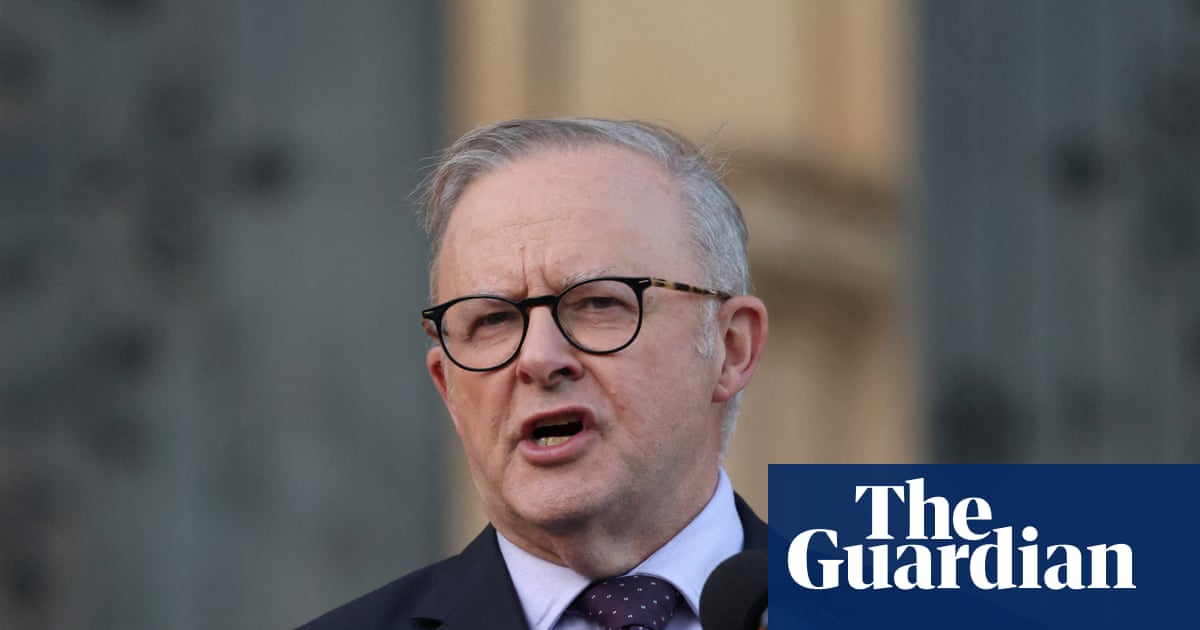
Hate speech laws will be expanded to directly target “hate preachers” under a new push to stamp out antisemitism, as Anthony Albanese concedes more could have been done to combat anti-Jewish sentiment ahead of the Bondi beach massacre.
The home affairs minister will also be granted powers to cancel and reject visas of people who spread “hate and division” under a five-point plan unveiled on Thursday, which followed days of intensifying pressure on the prime minister to do more to address antisemitism and radicalisation following Sunday’s terrorist attack on a Hanukah celebration.
It came as mourners gathered in Sydney for the funeral of 10-year-old Matilda – the youngest of the 15 victims.
“Look, of course more could have always been done. Governments aren’t perfect. I’m not perfect,” Albanese said.
Responding to Albanese’s admission, the opposition leader, Sussan Ley, said “more should have been done” to combat antisemitism in Australia in the aftermath of Hamas’s attack on Israel on 7 October 2023 as she unveiled her own plan.
The Coalition’s plan includes terminating or blocking funding to arts and research projects that support “antisemitic activities”, reviving the idea of stripping citizenship from dual citizens who engage in terrorist activities, and pausing the issuing of visas to any person from a “terrorist enclave” – including Gaza.
Ley demanded Albanese recall parliament next week to pass laws before Christmas.
The prime minister’s focus on tightening gun control laws in the immediate aftermath of Sunday’s shooting prompted claims, including from former Liberal prime minister John Howard, that he was attempting to distract from a failure to properly respond to a rise in antisemitism.
Albanese, who convened the national security committee on Thursday morning, said the government “adopts and fully supports” Jillian Segal’s plan to combat antisemitism. However, a document outlining the new plan only says the government would “work through” the implementation of the 13 recommendations.
The five-point plan announced on Thursday included an aggravated hate speech offence for preachers and leaders who promote violence, increased penalties for hate speech promoting violence and making hate an aggravating factor in sentencing crimes for online threats and harassment.
It would also include developing a regime for listing organisations whose leaders engage in hate speech, promoting violence or racial hatred, and developing a narrow federal offence for serious vilification based on race or advocating racial supremacy, he said.
The changes would broaden the hate speech laws that passed federal parliament earlier this year, which created a new criminal offence for encouraging violence against specific groups.
The government originally intended to include anti-vilification provisions in the bill, before it was dropped amid push back from faith groups.
Albanese did not rule out recalling parliament over summer to debate the new laws, although he was conscious the “complex” changes needed to be drafted properly to withstand legal challenge.
He also wanted to secure “broad support across the parliament”.
Authorities have alleged the shooting at Bondi – Australia’s worst ever terrorist attack – appears to have been inspired by Islamic State.
The home affairs minister, Tony Burke, said the new laws would lower the threshold to prosecute hate speech, adding individuals and organisations could currently “go right to the limits of the law” without breaking it.
“There have been organisations which any Australian would look at and say, their behaviour, their philosophy and what they are trying to do is about division and has no place in Australia,” Burke said.
“And yet, for a generation, no government has been able to successfully take action against them because they have fallen just below the legal threshold. Today, we’re announcing that we’re shifting the threshold.”
The federal police commissioner, Krissy Barrett, revealed “hate preachers” were already on their radar.
Burke did not single out any groups that might be listed under the new regime, which government sources confirmed would be separate to the process of designating a terrorist organisation.
The Islamic political organisation Hizb ut Tahrir and neo-Nazi group National Socialist Network could be possible targets, after Asio boss Mike Burgess last month said both used tactics that “stretch the boundaries of legality without breaking them”.
Albanese acknowledged Australia had witnessed an increase in antisemitism since 7 October 2023, which “culminated on Sunday in one of the worst acts of mass murder that this country has ever seen”.
“It was an attack on our Jewish community – but it was also an attack on the Australian way of life. Australians are shocked and angry. I am angry. It is clear we need to do more to combat this evil scourge, much more,” he said.
Ley, who attended Matilda’s funeral with her Jewish colleague Julian Leeser, said the new measures should have been announced two years and “then, just as a start”.
“While there is sadness in the Jewish community, there is also white hot, palpable anger at a prime minister who has had so many opportunities to take action, so many opportunities to show leadership, but on every occasion, his work and his words miss the mark, and it always comes too late,” Leeser said.
The Greens justice spokesperson, David Shoebridge, said there was a case for targeted measures to address hate crimes but cautioned that banning organisations could spur more division.
“In an open society there must be scope to freely criticise the actions of state actors that engage in acts of violence or discrimination,” he said.
“Simply outlawing criticism is not an answer to complex international issues.”
In a separate measures announced by the education minister, Jason Clare, business leader David Gonski would chair a taskforce to tackle antisemitism across the education system.
“Children aren’t born antisemitic. Children aren’t born racist. Children aren’t born with hate in their hearts. This is something that’s taught. This is something that’s learned,” Clare said.
The eSafety commissioner, Segal and the federal communication department will also develop advice on addressing antisemitism online.
