

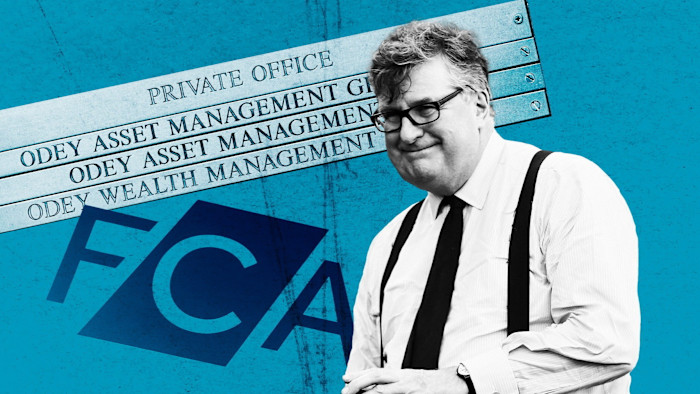
Festive cheer was in short supply at Crispin Odey’s Chelsea home on Christmas Eve of 2021, when the financier fired off letters sacking his hedge fund’s executives and stopping them investigating sexual harassment allegations against him.
The abrupt move set off a chain of events that led to Odey being banned from working in Britain’s financial sector and fined £1.8mn by the regulator last year in a decision he is challenging in a London court case that is due to start on Monday.
The gambit by Odey to rebuild his reputation will provide a crucial test of the UK Financial Conduct Authority’s powers. His appeal comes after the shuttering of the hedge fund he founded, Odey Asset Management, in the wake of allegations of sexual misconduct brought by a number of women being reported by the FT and other media.
The lurid details of the allegations against Odey and his aggressive response, including swearing at regulators and threatening executives, mean the proceedings in the Upper Tribunal are likely to attract attention outside the City of London and have a reputational impact beyond whether Odey succeeds or fails in his appeal.
Yet the outcome of the case will not depend on whether Odey sexually harassed various women who worked for the hedge fund he founded and owned.
Instead, it will focus on how Odey reacted to the firm’s attempts to discipline him in relation to the allegations, and whether the FCA was right to conclude he was “reckless” in breaching its rules and demonstrated “a lack of integrity” in trying to frustrate executives’ attempts to investigate his behaviour.
“As we often see in these types of cases with the FCA, the issues are primarily about the way the issues were managed when they came to light rather than the underlying allegations,” said Gayathri Kamalanathan, co-head of the financial institutions group at law firm Slaughter and May.
Odey hopes to convince the judge that he was forced to take drastic action to save his hedge fund. He will argue that it would have collapsed if its executives had ousted him in response to pressure from the FCA and the wider #MeToo movement against sexual harassment, according to written legal arguments.
Odey separately faces a trial in June that will combine personal injury claims brought by five women against him and a libel case he brought against the FT over its reporting of 19 women’s sexual misconduct allegations. Odey strenuously denies both sets of allegations.

There are parallels between Odey’s case against the FCA and the challenge Jes Staley brought last year against similar penalties the watchdog imposed on the former Barclays boss for playing down his relationship with the late sex offender Jeffrey Epstein.
Odey even made an unexpected courtroom appearance during the final days of that case, seemingly to show support for Staley, although the judge later upheld most of the regulator’s findings against the former Barclays boss.
Just as Staley’s attempt to overturn the FCA ban revealed intimate emails that he had exchanged with Epstein — which the former Barclays chief said had been a “public humiliation” and put his marriage in jeopardy — Odey’s challenge also risks unearthing uncomfortable details.
These include the 46 allegations of misconduct towards female employees uncovered by an internal investigation, such as when one woman claimed he brought a skirt into his office and required a receptionist to try it on and show it to him to check if it would fit his daughter, according to the FCA’s statement of case.
Claire Cross, a former FCA lawyer now a partner at law firm Corker Binning, said: “As we saw in the Staley case, once you stand up in the tribunal you do not get to limit what you say to the narrow challenge you are bringing. There is a risk that you are opening Pandora’s box.”

A former Conservative Party donor and Brexit supporter who made his name betting against British banks in the 2008 financial crash, Odey fell from grace after the FT detailed allegations of sexual harassment and assault against him stretching over several decades.
Since banks cut their ties and investors demanded their money back, Odey Asset Management has been in the process of winding down and transferring its funds to rivals. It stopped being authorised by the FCA in 2024.
The hedge fund founder’s lawyers argued in court documents that the FCA was under “political pressure” to take action against him. They said the regulator had an “agenda” to go after non-financial misconduct and was seeking “a totemic case”, which meant Odey was facing “an unfair process” in front of his executive committee.
Odey justified his decision to twice fire the executive committee under the “12-week rule” that gives an exemption to management edicts in an emergency. He also believed his alleged behaviour towards women was irrelevant for deciding if he could work at his hedge fund, telling a colleague: “HR law did not matter here,” according to the FCA’s statement of case.
The tribunal could find in favour of Odey and reverse the FCA’s ban and fine. Nathan Willmott, a regulatory investigations partner at law firm Ashurst, said one potential outcome was that “the judge could uphold the FCA’s prohibition of Odey for lacking integrity but decide his behaviour did not amount to a breach of the FCA’s conduct rules and so overturn the fine”.
However, lawyers also said Odey’s case could be hampered by how he dealt with the regulator. The FCA’s statement of case accuses him of making a “false assertion of fact” when he told a regulatory official that one of their colleagues had said his disciplinary hearing could be delayed.
When the official rejected this, he threatened to “go straight to the fucking press” and said: “You will not get away with this — I have an agreement then you little guys, trying to do your work in the shadows . . . You are about to create a crisis,” the statement of case reads. He also said the FCA “have nothing on me” and accused it of “sneaking around in the shadows”.
Odey’s lawyers have said in their response to the FCA that his language in discussions with the FCA sometimes reflected his “emotional response to the position he finds himself in”.
“Odey may well have been the architect of his own downfall,” said Cross at Corker Binning.

“If you operate in a regulated sector, you inevitably have to follow the regulator’s rules but there are ways of playing the game,” she added. “To use football as an analogy: something that happens on the pitch might be perfectly legal in general terms but it can still break the rules of the game and earn a red card from the referee.”
In February 2021, after an internal investigation found Odey had behaved inappropriately with female employees, the firm gave him a “final written warning”, according to both sides’ court documents. As part of this warning, Odey agreed to no longer communicate with female staff about non-work matters, invite female staff to lunch or engage in unwanted touching.
But a few months later, the committee was told by a staffing agency that it would stop providing temporary workers to the hedge fund after Odey behaved inappropriately with one of its receptionists, prompting it to arrange a disciplinary hearing for its founder, according to the FCA’s statement of case. Odey has responded that the receptionist did not complain to him.
Tim Pearey, the hedge fund’s chief executive at the time, told Odey that the hearing could result in him being removed from the partnership of the firm he founded if it were concluded that he breached his final warning. Odey responded by threatening to fire Pearey and shut down OAM.
After firing all three executive committee members a few days later on Christmas Eve and then holding a meeting as its only member, Odey postponed the disciplinary hearing because he was “unable to conduct it with impartiality”.
Having appointed a new committee, he urged them to postpone the disciplinary hearing until the FCA had finished its own investigation into his behaviour. When the committee proposed “safeguarding measures” to separate Odey from other staff members in response to another allegation of sexual harassment, he called committee members “fucking spineless” and fired them a second time in March 2022, the FCA alleges in its statement of case.
His lawyers responded to the FCA: “It does not demonstrate a lack of integrity or fitness and propriety on the part of Mr Odey to use levers properly available to him to secure a just hearing to prevent unnecessary wide harm.”
The regulator’s statement of case claims that Odey’s actions were “deliberately designed to frustrate OAM’s disciplinary process to protect his own interests”. It adds that he “showed a reckless disregard” for its governance and compliance with regulations.
As the hedge fund’s majority owner, Odey had the right to fire its executive committee. But the FCA alleges that this breached the firm’s obligation to always be managed by at least two suitably qualified people. Appointing himself also allegedly created a conflict of interest, as Odey was both a fund manager and in charge of risk management.
Odey argues in his court documents that because he was acting as a controller of the company his actions were “therefore outside the disciplinary jurisdiction of the Authority.”
The City has changed in the years since Odey fired off his Christmas Eve missives to his executive board. Not least because the FCA announced new rules last year for non-financial misconduct, including sexual harassment, which come into force in September. Next week’s trial will be a critical test of how City bosses were held to account absent those concrete rules.
