

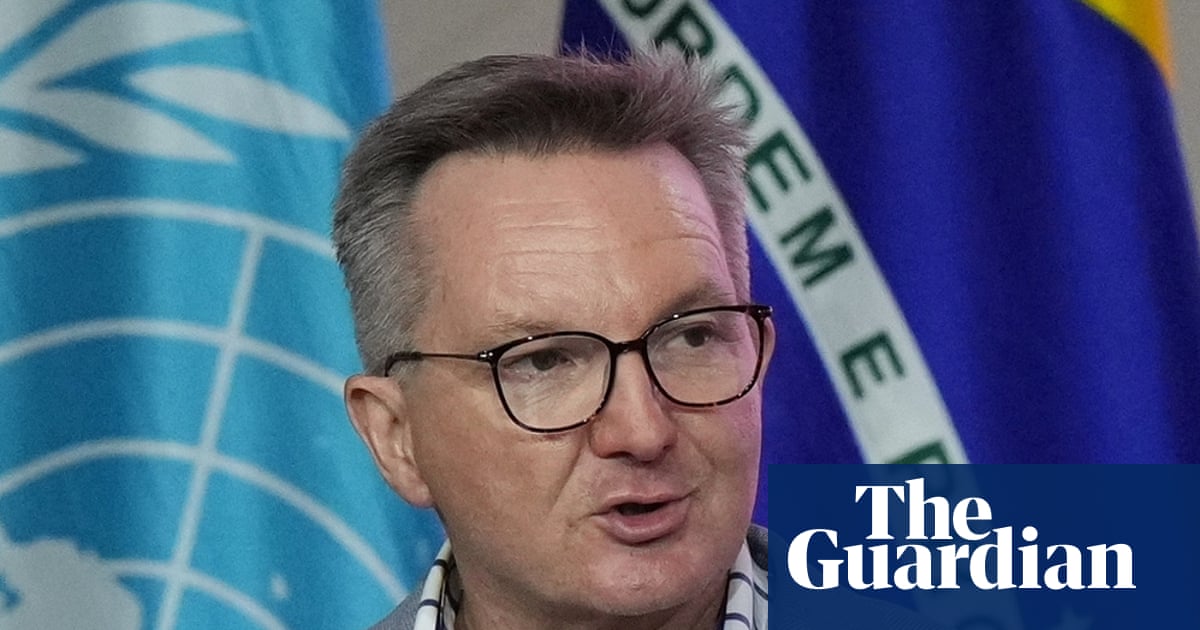
Experts have dismissed claims Chris Bowen cannot remain a senior minister while playing a leading role in international climate negotiations, with one describing the argument as evidence of an Australian “culture cringe”.
Australia failed in its long-running bid to co-host the Cop31 climate summit with Pacific nations next year after Turkey refused to withdraw from the consensus process despite limited support.
In negotiations at the UN Cop30 summit in Brazil, an unprecedented deal was struck in which Turkey would host and run the event, including a massive green trade fair, in the resort city of Antalya, while an Australian – Bowen, the climate change and energy minister – would be appointed vice-president and “president of negotiations”.
According to the agreement, Bowen would be given “exclusive authority in relation to the negotiations” between nearly 200 countries, starting immediately. His role will include presiding over a pre-Cop31 meeting in the Pacific late next year.
The Coalition attacked the government over the appointment in parliament on Monday, describing him as “president Bowen” and claiming he would be a “part-time minister, full-time president” when he should be focused on lowering energy bills. The opposition leader, Sussan Ley, asked how long Bowen – who was absent as he was still returning from Brazil – would spend overseas.
The prime minister, Anthony Albanese, said the “crunch points” on negotiations would be late next year. He said Bowen’s role would be important to Pacific countries, where addressing the climate crisis was “the first priority, the second priority, and the third priority” as without it “countries like Kiribati and Tuvalu will disappear”.
Climate experts said governments minister usually stayed in their domestic roles while serving as president leading the global summit known as Cop (short for Conference of the parties to the UN Framework Convention on Climate Change).
Of the 10 Cops held since the landmark Paris agreement was reached in 2015, seven have been led by continuing government ministers, one by a prime minister and one by a senior diplomat.
The 10th, in Glasgow in 2021, was led by Alok Sharma, who was UK minister for business, energy and industrial strategy when appointed as Cop president. He later left the ministry and became a full-time president, but stayed in the UK cabinet.
Erwin Jackson, a veteran observer at climate talks now at Monash University’s Climateworks centre, said Sharma’s role was larger than Bowen’s, as he was hosting the summit in the UK and the Glasgow conference was a “decision-making Cop” that required the leader to spend the year galvanising a global effort on new emissions reduction targets.
By comparison, Cop31 will be focused on implementation of commitments, and holding together and building on the fragile agreement reached in Brazil.
Jackson said Antalya would not be a major conference where countries were expected to make major decisions as they had in Paris, Glasgow or Kyoto, where the first agreement to limit emissions was reached in 1997.
“Sharma was travelling around the world trying to get countries to sign up to net zero. Bowen doesn’t have to do that,” he said.
Jackson said it was in Australia’s national interest to get the world to act on climate change and it was an example of “culture cringe and tall poppy syndrome” to suggest an Australian minister could not lead the negotiations.
after newsletter promotion
“An Australian minister can absolutely do the job when we have had ministers from all over the world do this job for more than 30 years,” he said.
“In the last 4o years of negotiations, Australia has been a climate pariah – from [Paul] Keating all the way through to [Scott] Morrison. The fact that Australia has now got the backing of the most progressive climate countries in the world, in western Europe and the Pacific, is something we should be celebrating.
“Let’s focus on whether the minister of the day is doing their job and have a debate on the substance, not his diary schedule.”
Richie Merzian, the chief executive of the Clean Energy Investor Group and a former climate diplomat, said Bowen could do both jobs, arguing ministers already juggled a number of roles, including as a local MPs.
“The situation is not pretty as there is no precedent, but it’s doable and if anyone could do it’s probably Bowen,” Merzian said. “It would be worse for a new minister to come in because we need to deliver on the [clean energy] transition.”
Howard Bamsey, a former Australian special climate envoy and now an honorary professor at ANU’s school of regulation and global governance, said as Australia had taken on leading the climate negotiations – a significant foreign policy task – the role should have national support.
He said Bowen had “an exceptionally demanding domestic role and exceptionally challenging task” internationally, and his success would depend on the backing he received from cabinet colleagues and the bureaucracy, including the Department of Foreign Affairs and Trade. He could be helped by the government appointing a “quasi-ministerial representative” who reported to the minister and handled significant parts of the negotiations.
“Don’t underestimate the scale of the challenge for Australia,” Bamsey said. “It will require a dedicated whole of government effort.”
