

Eddie Miles braved snow and train delays when travelling to Aberdeen in 2010 for BrewDog’s first annual general meeting but relished the chance to take a tour of the company’s original brewery, drink “plenty of free beer” — and going on to scoop up around £650 worth of shares.
Yet the 64-year-old architect and craft beer enthusiast now fears he will be left empty-handed after the company appointed restructuring firm AlixPartners earlier this month to run a sales process that could involve breaking up the UK’s biggest independent beer company.
It is the latest chapter in a tale that has seen BrewDog go from a poster child of the craft beer movement to criticism of its workplace culture and years of financial losses.
For tens of thousands of retail investors like Miles, who invested more than £75mn in BrewDog through crowdfunding between 2009 and 2021 and were dubbed ‘equity punks’, the drama has left a bitter taste.
They expect their investment will be wiped out following a potential sale because of a 2017 deal in which US private equity firm TSG Consumer Partners took a stake in the company and BrewDog’s later disappointing performance.
For TSG to acquire their class of preferred shares, BrewDog co-founders James Watt and Martin Dickie removed a key investor protection, so-called pre-emption rights. TSG injected £213mn and gained control of more than 20 per cent of BrewDog on terms that included a coupon entitling it to a compound annual return of 18 per cent at the moment of any sale.
That deal established the company as a unicorn, valuing it at £895mn and making the fortunes of its co-founders. Due to the compounding coupon, TSG’s stake has since continued to swell in value.
BrewDog’s own fortunes, however, have changed. Sales growth has ground to a halt with the company reporting a pre-tax loss of £36.7mn for 2024, the latest figure available and marking a fifth consecutive annual loss. It also then had £240mn in net debt.
In order for the ‘equity punks’, to make a return, a sale price would likely need to exceed the combined sum of BrewDog’s net debt and the compounded value of TSG’s stake, together estimated at more than £1bn. That threshold is likely to prove challenging.

The company said the decision to call in AlixPartners was “a deliberate and disciplined step with a focus on strengthening the long-term future of the BrewDog brand and its operations” and cited a “challenging economic climate”.
BrewDog had already begun to trim its portfolio, halting production of gin and vodka brands at its distillery in Aberdeenshire last month and selling a Scottish rewilding estate it had acquired last year. It has closed 10 bars in the UK, including its flagship in Aberdeen, and laid off some staff.
On the sales block now are its brands, its brewing operations and the remaining 72 pubs and restaurants.
Aside from co-founder Watt, who has previously expressed interest in buying back the business, a person close to the sales process said they expected that most bidders would look to break up BrewDog.
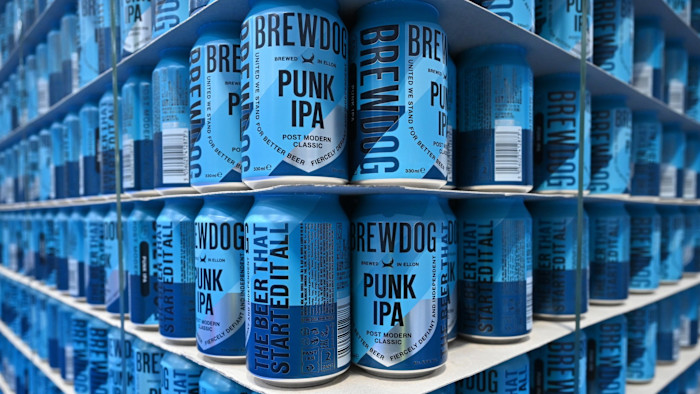
BrewDog, founded close to Aberdeen in 2007, tapped into the growing market for craft beers and expanded rapidly, drawing in drinkers with creatively named beverages such as Elvis Juice and Punk IPA.
Its growth was fuelled by a series of publicity stunts and ‘equity for punks’ crowdfunding campaigns, with AGMs — themselves dubbed ‘annual general mayhem’ — that Miles said “felt like festivals”.
At the forefront of the UK’s craft brewing boom, BrewDog required all employees, from servers to accountants, to study for the industry qualification Cicerone’s Certified Beer Server. It also launched its own chain of bars and restaurants.
“The speed at which they expanded was probably ultimately the thing that undid them,” said Nick Pye, founding partner at Mangrove Consulting.
Some felt that BrewDog lost focus, particularly as it pushed into the UK’s fiercely competitive hospitality industry. “Finding ways to make sure we didn’t get distracted from the core business was always a friction,” said one former employee who spent more than a decade at the company.

The person added that BrewDog had “changed dramatically” as it expanded: “The business at the start had a real culture of being scrappy and doing more with less, but I don’t think it’s possible for a company to grow that fast without feeling the pressure.”
The company’s reputation was also scarred by claims from staff of a “toxic” work environment, with a group of former employees alleging a “culture of fear” and misogyny in an open letter in 2021.
Watt, then BrewDog’s chief executive, issued a public apology. But the group was also hit by a backlash in 2024 after dropping its commitment to pay all staff the so-called real living wage, a move that some felt was in conflict with the brand’s purported values.
Watt stepped down as chief executive in 2024. His replacement James Arrow departed last March after less than a year in the role and was succeeded by former chief financial officer James Taylor.
Having endured a difficult period during Covid-enforced closures, competitors were also snapping at their heels.
“You can find much more exciting and accessible avenues to craft beer in most cities nowadays,” said 36-year-old Aaron Bourn, another disillusioned retail investor. “It’s as if BrewDog started the bandwagon which everyone else jumped on — but then they fell off it themselves.”
Analysts and insiders have suggested that the company’s brewing facilities in Scotland, the US, Australia and Germany may be of interest to groups such as Carlsberg and Heineken, while some or all of its portfolio of more than 70 bars and restaurants could attract bids from rival pub chains.
The company’s most famous brands, particularly Punk IPA, could be snapped up by a rival drink maker, said Sarah Warman, who worked in marketing and ended up as communications chief at BrewDog until 2025.
BrewDog said it would “not comment on any further speculation” about its assets or how the sale might affect its so-called ‘equity punks’.
TSG and AlixPartners declined to comment. Watt declined to comment but a person close to him said he has external financing to make a bid.
Warman told the FT that as the most popular craft beer in UK supermarkets, Punk IPA was “often more well recognised than BrewDog itself” and could “have a life of its own outside the company’s baggage”.
That is of cold comfort to retail investor Miles who is now “conflicted” about buying BrewDog’s products — even though he still likes them. “[My interests as an investor] have been jettisoned,” he said.
