

November 26, 2025
1 min read
Magnitude 4.0 Earthquake Rattles Bay Area, with Aftershocks Likely to Follow
A minor earthquake struck California in the early hours of the morning on November 26
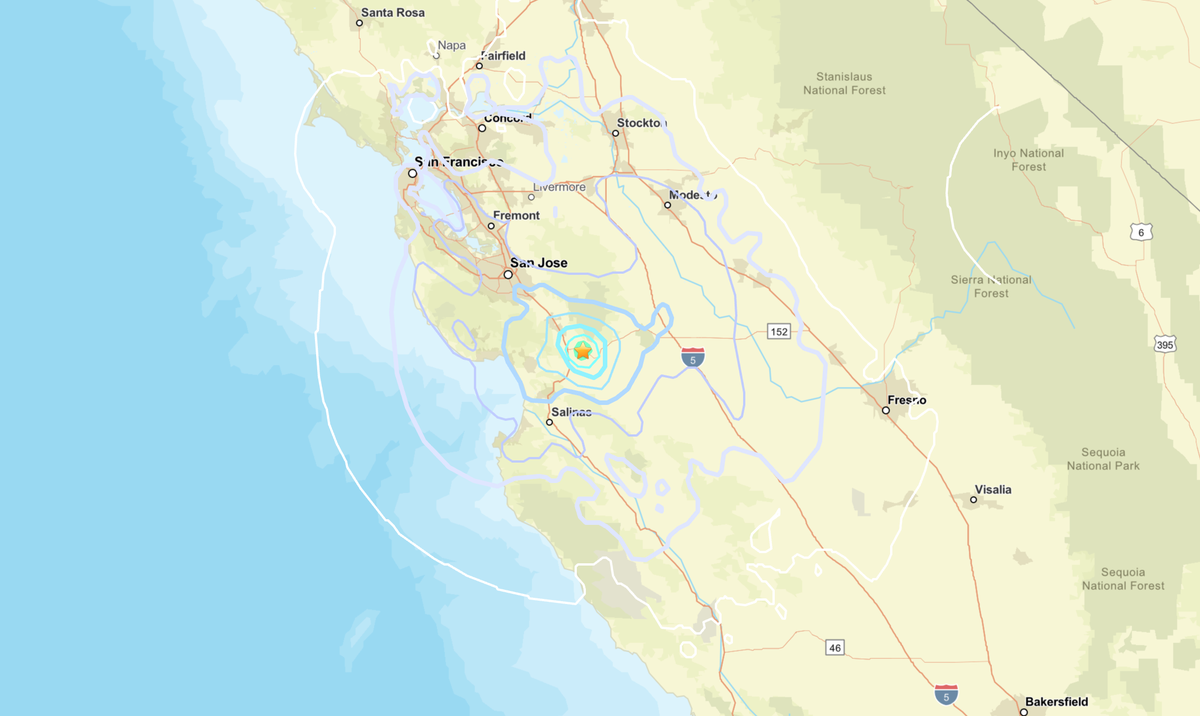
An earthquake of magnitude 4.0 rattled the Bay Area shortly after 6 A.M. local time on November 26—the quake is the largest so far in a string of recent activity near Gilroy, Calif.
The U.S. Geological Survey had originally estimated the earthquake to be magnitude 4.3 but quickly revised the strength down to 4.0. That kind of revision is typical in the immediate aftermath of a quake as scientists analyze the data available to them.
The earthquake’s epicenter was 1.7 miles deep and about five miles east of Gilroy, south of San Francisco Bay and located about halfway between San Jose and Salinas, inland from the coast. The National Tsunami Warning Center quickly determined that the event did not pose any threat of a tsunami.
On supporting science journalism
If you’re enjoying this article, consider supporting our award-winning journalism by subscribing. By purchasing a subscription you are helping to ensure the future of impactful stories about the discoveries and ideas shaping our world today.
The quake is the latest in a string of geological activity located in the area; USGS has identified 10 tremors in recent weeks that might be connected to this largest-yet event. The prior temblors were predominantly weaker than magnitude 2.0, which people usually do not feel.
Since the magnitude 4.0 event, two smaller quakes—located deeper in Earth’s crust than the larger one—have already occurred: first a magnitude 2.7 tremor just to the northeast, then a magnitude 3.6 quake to the southwest of both these events.
Whether or not you felt the recent earthquakes, if you were in the area, you can report your experience to USGS to better inform its analysis of the event.
It’s Time to Stand Up for Science
If you enjoyed this article, I’d like to ask for your support. Scientific American has served as an advocate for science and industry for 180 years, and right now may be the most critical moment in that two-century history.
I’ve been a Scientific American subscriber since I was 12 years old, and it helped shape the way I look at the world. SciAm always educates and delights me, and inspires a sense of awe for our vast, beautiful universe. I hope it does that for you, too.
If you subscribe to Scientific American, you help ensure that our coverage is centered on meaningful research and discovery; that we have the resources to report on the decisions that threaten labs across the U.S.; and that we support both budding and working scientists at a time when the value of science itself too often goes unrecognized.
In return, you get essential news, captivating podcasts, brilliant infographics, can’t-miss newsletters, must-watch videos, challenging games, and the science world’s best writing and reporting. You can even gift someone a subscription.
There has never been a more important time for us to stand up and show why science matters. I hope you’ll support us in that mission.
