

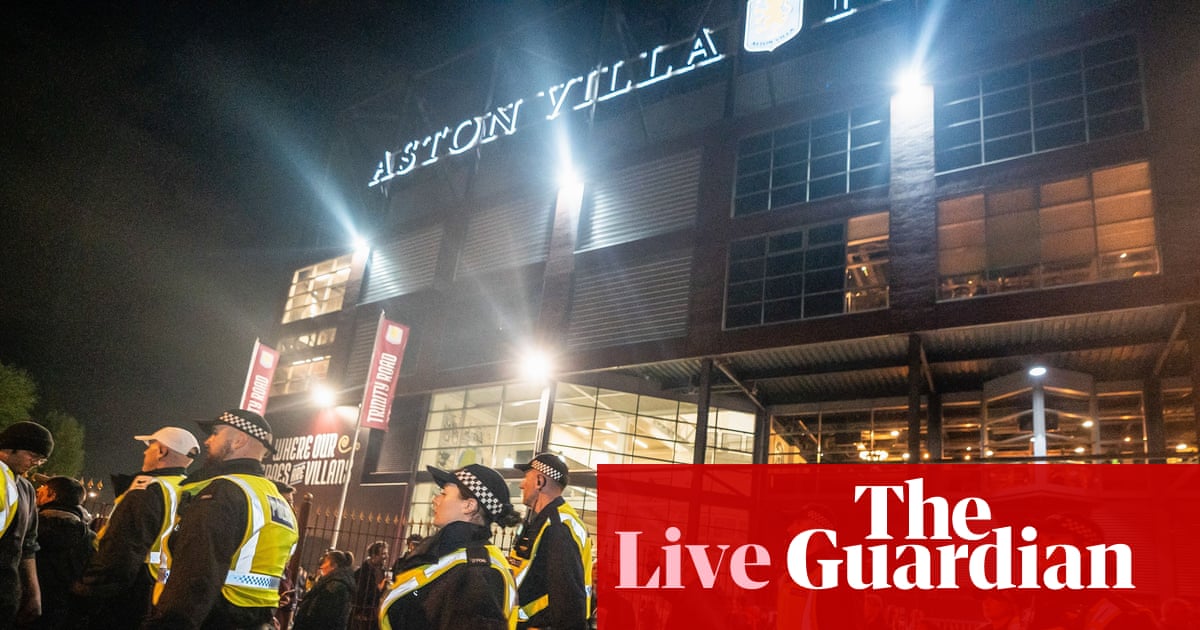
Risk of Maccabi Tel Aviv facing antisemitic attacks not ‘predominant’ reason for match ban, police chief tells MPs
MPs have been told that the risk of antisemitic hate crime was not the “predominant” reason why West Midlands police wanted to ban Maccabi Tel Aviv fans from attending the Europa League match at Aston Villa.
Mike O’Hara, WMP’s assistant chief constable, said in a letter to the Commons home affairs committee that the threat of violence by Maccabi fans was a more important consideration.
The letter, which has been published this afternoon by the committee, confirms reporting by the Guardian last month which said that the fans were banned “after police intelligence concluded the biggest risk of violence came from extremist fans of the Israeli club”.
Keir Starmer and other political leaders reacted with outrage after the ban was first announced in October. Starmer suggested the police were accepting they would not be able to protect the Maccabi supporters from antisemitic violence, and he said: “The role of the police is to ensure all football fans can enjoy the game, without fear of violence or intimidation.”
In the Commons Lisa Nandy, the culture secretary, did not contest this intrepretation, saying that the police wanted to ban Maccabi fans “in no small part” because of the risk they faced being Jewish.
Ministers tried to get the police, and Birmingham city council’s safety advisory group (which took the final decision based on police advice), to reconsider. But these efforts proved fruitless after Maccabi decided not to apply for tickets for its fans anyway.
In his letter to the committee, O’Hara says:
West Midlands police identified the potential for antisemitic incidents in connection with the fixture. While the risk of antisemitic hate crime was acknowledged as a relevant concern, it was not assessed to be the predominant threat.
The principal risks outlined in the force’s assessment included spontaneous public disorder, antisocial behaviour, organised protest activity, and violence involving risk supporters affiliated with Maccabi Tel Aviv. The cumulative impact of these factors led to the fixture being classified as high risk, with antisemitism recognised as one of several contributing elements.
In his letter, sent in response to questions posed by the committee, O’Hara also presents WMP’s assessment of the conduct of Maccabi fans at a match against Ajax in Amsterdam in November 2024. He says:
Intelligence indicated that, on the day preceding the fixture, between 500 and 600 Maccabi fans deliberately targeted Muslim communities, committing hate-motivated offences including serious assaults on Muslim taxi drivers, singing hate fuelled songs and tearing down Palestinian flags.
Dutch police described the Maccabi Tel Aviv risk group as highly organised and experienced in violent confrontation. On match day, there were widespread incidents of vandalism, assaults, and running street battles. The Dutch police response saw 5,000 officers deployed over a number of days and mass arrests were made from both sides.
Yesterday the Sunday Times published a report quoting Dutch police as saying that this intelligence cited by WMP was wrong. For example, the police said that only 1,200 officers were deployed in total, and they questioned the claim that up to 600 fans deliberately targeted Muslim communities.
The report has prompted the Tory MP Nick Timothy to table an urgent question on this in the Commons which will start after 4pm. (See 1.05pm.)
Key events
Former MI6 counter-terrorism chief suggests law shouldn’t treat holding Palestine Action placards as terrorism
Haroon Siddique
Haroon Siddique is the Guardian’s legal affairs correspondent.
A former security services chief has said it is wrong that people have been branded terrorists for allegedly holding up signs supporting Palestine Action.
More than 2,000 people have been arrested on suspicion of showing support for Palestine Action since the ban on the direct action group under the Terrorist Act took effect on 5 July, placing it alongside the likes of Islamic State and Boko Haram.
Most are accused of holding signs saying: “I oppose genocide, I support Palestine Action.”
Speaking ahead of the legal challenge to proscription of Palestine Action, which is due to begin on Wednesday, the former global counter-terrorism director of MI6, Richard Barrett, said:
What those people were doing holding up placards could not be considered a threat to national security, in my view, and therefore there shouldn’t have been a legal framework which allowed those terrorist charges to be brought against them.
I think those protesters just calmly holding placards were also demonstrating that they had lost trust in the system of government and the processes in which the government might declare a group [to be] terrorist and proscribe it.
If the law is not working, one should look quite carefully at why it’s not working and this law is not being respected, then one should look quite carefully at the whole process involved. On the face of it, the police were doing their duty [by arresting them] but I can’t think many police would have thought that’s the best use of their time.
The judicial review of the decision to ban Palestine Action was supposed to start tomorrow but has been postponed by a day due to one of the lawyers being ill.
Barrett is part of an independent counter-terrorism commission set up by the Bingham Centre for the Rule of Law, which published its report earlier this month.
The Home Office has consistently responded to criticism of the ban by saying that supporting Palestine is not the same as supporting a proscribed terrorist organisation.
Starmer ‘significantly increased’ risks associated with Maccabi fan ban by implying link to antisemitism, Labour PCC says
Keir Starmer “significantly increased” the risks associated with the Maccabi Tel Aviv Europa League match at Aston Villa when he denounced the ban on its fans, the West Midlands police and crime commissioner (PCC) has said.
Simon Foster, who is a Labour PCC, criticised the PM in a letter to the Commons home affairs committee today, published alongside a letter from the West Midlands police (WMP). (See 2.24pm.)
Foster and WMP were both replying to questions submitted by the committee. But, in his reply, Foster suggests, “respectfully”, that the committee should also be asking questions of other people, including Starmer.
Foster says:
It is undeniable that the prime minister’s intervention significantly increased the risks associated with the fixture, by not only criticising the decision, but also confusing who actually made the decision – it was not the police – and implying, that the decision was related to, or even motivated by, antisemitism.
The committee might usefully inquire of the prime minister as to the process via which he acquainted himself with the facts and the evidence, before he concluded the decision was wrong and then decided to make such an intervention and in particular, what advice he received before doing so and what led him to use the form of words he did.
Foster also said that, when Starmer posted a tweet saying that banning Maccabi fans was wrong because it suggested that antisemitism was being tolerated, he implied that the government was not aware that WMP was likely to recommend a ban. But the Home Office had been told about that the previous week, Foster said.
Foster also said that Starmer was implying with his tweet that WMP was willing to accept antisemitism. Foster went on:
The prime minister’s post could be interpreted as asserting that the advice given by WMP, or indeed the [safety advisory group’s] decision, were motivated by antisemitism. These are grave accusations. The prime minister has provided no evidence to support this assertion and again I submit, this question could be put to the prime minister and officials.
Foster said that when the match did go ahead, it passed off relatively peacefully. But the policing operation cost £2m, he said. He said WMP should get a grant to compensate for this.
The Commons culture committee hearing where Samir Shah, the BBC chair, Sir Robbie Gibb, the former Tory spin doctor who sits on the BBC board, and Michael Prescott, the adviser who wrote the memo that has encouraged Donald Trump to sue the corporation for at least $1bn, is starting at 3.30pm. Frances Mao is covering it on a separate live blog which you can read here.
IFS thinktank questions wisdom of international student levy, saying it’s ‘unusual for country to tax its exports’

Sally Weale
Sally Weale is the Guardian’s education correspondent.
The government’s planned levy on international student fees, details of which are expected to be fleshed out in this week’s budget, would constitute a tax on a major UK export, a leading thinktank has warned.
The Institute for Fiscal Studies (IFS) called on ministers to explain the economic rationale behind the controversial surcharge, which vice-chancellors have warned will leave many already struggling universities even worse off.
In a new analysis of the government’s recent post-16 education and skills white paper, the IFS said:
The government has not yet set out any strong economic rationale for the introduction of an international student levy.
Providing education to international students counts as one of the UK’s export activities, and any lost fee income from prospective international students deterred from studying in the UK would amount to a reduction in UK exports.
While taxes on imports (tariffs) are fairly common, it is unusual for a country to tax its own exports.
The IFS also questioned the government’s claim that the money raised from the levy will fund the return of maintenance grants for low income students who sign up to priority subjects that support Labour’s industrial strategy. It said:
If total spending on maintenance grants is genuinely tied to the amount raised through the levy, this is unlikely to represent good policymaking as there is no reason that optimal spending on these grants would match – or evolve over time in the same way as – levy revenues.
The planned return of maintenance grants will be welcome to those who qualify for them, but restricting eligibility to those studying ‘priority’ subjects means only a minority of low-income students are likely to benefit directly.
As a result, these reforms are unlikely to resolve wider concerns about the generosity of support for students’ living costs, or inequalities in access to higher education.
The IFS intervention was welcomed by Universities UK, which represents higher education leaders. UUK chief executive Vivienne Stern said:
Having a respected body like the IFS call this a ‘tax on a major UK export’ must act as a wake-up call.
We urge the government to drop this proposal ahead of the budget ant take the necessary time to fully consider the implications of introducing such a levy.
The Department for Education says it has taken action to put the sector on a secure financial footing, including committing to raise the maximum cap on tuition fees annually and refocusing the higher education regulator for England, the Office for Students, to support universities to face the challenges of the future.
Risk of Maccabi Tel Aviv facing antisemitic attacks not ‘predominant’ reason for match ban, police chief tells MPs
MPs have been told that the risk of antisemitic hate crime was not the “predominant” reason why West Midlands police wanted to ban Maccabi Tel Aviv fans from attending the Europa League match at Aston Villa.
Mike O’Hara, WMP’s assistant chief constable, said in a letter to the Commons home affairs committee that the threat of violence by Maccabi fans was a more important consideration.
The letter, which has been published this afternoon by the committee, confirms reporting by the Guardian last month which said that the fans were banned “after police intelligence concluded the biggest risk of violence came from extremist fans of the Israeli club”.
Keir Starmer and other political leaders reacted with outrage after the ban was first announced in October. Starmer suggested the police were accepting they would not be able to protect the Maccabi supporters from antisemitic violence, and he said: “The role of the police is to ensure all football fans can enjoy the game, without fear of violence or intimidation.”
In the Commons Lisa Nandy, the culture secretary, did not contest this intrepretation, saying that the police wanted to ban Maccabi fans “in no small part” because of the risk they faced being Jewish.
Ministers tried to get the police, and Birmingham city council’s safety advisory group (which took the final decision based on police advice), to reconsider. But these efforts proved fruitless after Maccabi decided not to apply for tickets for its fans anyway.
In his letter to the committee, O’Hara says:
West Midlands police identified the potential for antisemitic incidents in connection with the fixture. While the risk of antisemitic hate crime was acknowledged as a relevant concern, it was not assessed to be the predominant threat.
The principal risks outlined in the force’s assessment included spontaneous public disorder, antisocial behaviour, organised protest activity, and violence involving risk supporters affiliated with Maccabi Tel Aviv. The cumulative impact of these factors led to the fixture being classified as high risk, with antisemitism recognised as one of several contributing elements.
In his letter, sent in response to questions posed by the committee, O’Hara also presents WMP’s assessment of the conduct of Maccabi fans at a match against Ajax in Amsterdam in November 2024. He says:
Intelligence indicated that, on the day preceding the fixture, between 500 and 600 Maccabi fans deliberately targeted Muslim communities, committing hate-motivated offences including serious assaults on Muslim taxi drivers, singing hate fuelled songs and tearing down Palestinian flags.
Dutch police described the Maccabi Tel Aviv risk group as highly organised and experienced in violent confrontation. On match day, there were widespread incidents of vandalism, assaults, and running street battles. The Dutch police response saw 5,000 officers deployed over a number of days and mass arrests were made from both sides.
Yesterday the Sunday Times published a report quoting Dutch police as saying that this intelligence cited by WMP was wrong. For example, the police said that only 1,200 officers were deployed in total, and they questioned the claim that up to 600 fans deliberately targeted Muslim communities.
The report has prompted the Tory MP Nick Timothy to table an urgent question on this in the Commons which will start after 4pm. (See 1.05pm.)
Lib Dems urge Starmer to rule out letting Russia rejoin G8 as part of any Ukraine peace settlement
The 28-point US peace plan for Ukraine that was leaked last week suggests that, as part of the settlement, Russia could be re-admitted to the G8 (or the G7 as it now is, following Russia’s expulsion after the annexation of Crimea in 2014).
The Liberal Democrats want Keir Starmer to rule this out. Calum Miller, the Lib Dem foreign affairs spokesperson, said:
Russia must not be readmitted to the G7. Putin is a war criminal who is also hell-bent on destabilising Europe and the rest of the international order. A ceasefire in Ukraine would not change those facts.
The prime minister should categorically rule out readmitting Russia to the G7. Anything less than a total block on Putin returning to the group would show authoritarians everywhere that aggression pays.
Kyle tells CBI he will not ignore business concerns when deciding how employment rights bill gets implemented
Peter Kyle, the business secretary, told business leaders that their concerns would not be ignored when the government decides how to implement the employment rights bill.
The measure is close to becoming law. But, when he spoke to the CBI this morning, Kyle stressed that many measures will be subject to consulation before they are implemented. He said:
Our manifesto committed us to consult, to listen, and that’s what I’ll do.
The primary legislation that is going through parliament now commits me to consult in 26 different areas, the law is going to require me to.
So it has been, yes, a frustration of mine that some of the area that will be filled in by the result of a consultation that meaningfully engages all sides and all voices has been filled by people projecting on to that their worst fears are of it. But that is not the reality that I will be driving towards.
Kyle said “the voice of people who work in business” would be heard in the consultation process. He went on:
I will not pit employer against employee or employee against employer … And all of the conjecture that you’ve heard about what the bill will and won’t deliver is based in areas for which the consultation on implementation has not even started.
The bill is being held up because, for the third time in a row, peers have voted against some of the key measures in the bill, including the provision for workers to get day-one protections against unfair dismissal. The parliamentary “ping pong” process has been going on for almost a month now, and the bill will not get royal assent until either the Lords, or the government, back down.
Asked if the government would compromise to end the standoff, Kyle said:
I’ll do what it takes to get it through, because I need to get on with the real business, which is implementing it.
Normally in these circumstances the government just keeps sending the bill to the Lords, and eventually peers accept the will of the elected chamber.
UPDATE: Richard Partington has the full story here.
There will be two urgent questions in the Commons today after 3.30pm, both tabled by Conservativess. A Cabinet Office minister will respond to a UQ from the Alex Burghart about the ministerial code, and then a Home Office minister will respond to a UQ from Nick Timothy about the intelligence used by West Midlands police to justify the ban on the Maccabi Tel Aviv fans from attending the Villa Park match.
Then, after 4.30pm, there will be an statement on the government’s critical minerals strategy by Chris McDonald, an industry minister.
Keir Starmer had a brief meeting with Li Qiang, the Chinese premier, at the G20 summit in South Africa, it has emerged.
The meeting was not disclosed when Starmer was at the summit. It is understood that it was just a brief meeting, not a formal bilateral, and that Starmer and Li did not discuss anything of substance.
No 10 says Britain ‘steadfast with Ukraine to keep it in the fight’
Downing Street has said that the UK remains “steadfast” alongside Ukraine and determined to “keep it in the fight”.
Asked about the latest talks on a peace settlement in Ukraine, the PM’s spokesperson told the lobby briefing this morning:
The prime minister obviously welcomes the significant progress made at yesterday’s meetings between the US and Ukraine in Geneva. As the US, Ukraine, joint statement makes clear, yesterday’s talks were a major step towards a just and lasting peace for Ukraine.
Of course, there are some outstanding issues, but as both countries have set out, intensive work on the peace plan will continue in the coming days and weeks, you can expect the prime minister to continue his engagement with world leaders this week.
While diplomatic efforts continue, we will stand steadfast with Ukraine to keep it in the fight, and ensure the Ukrainian people can defend themselves during ongoing barbaric attacks like we saw last night, and in the long term.
The spokesperson also said that Russia “consistently pretends to be serious about peace, but its actions never live up to its words”.
Starmer is expected to host a virtual meeting tomorrow of leaders for “Coalition of the Willing” countries to discuss the Ukraine plan.
Two peers suspended from House of Lords for breaking lobbying rules
Two long-serving peers are to be suspended from the House of Lords after a parliamentary watchdog ruled that they had broken lobbying rules.
Richard Dannatt, the former head of the British army, and David Evans (Lord Evans of Watford), were filmed breaking the rules in undercover footage recorded by the Guardian.
Henry Dyer and Rob Evans have the story.
The Lord conduct committee’s report into Dannatt is here, and its report into Evans is here.
Are Tories right to say Reeves using budget tax rises to fund ‘welfare splurge’?
The Conservatives are attacking the budget by saying that taxes are having to go up to pay for extra welfare spending. Or, as Mel Stride, the shadow chancellor, puts it in an article for the Daily Telegraph:
That is exactly what Labour looks set to deliver at this week’s budget: a multi-billion-pound welfare splurge, funded by stealth tax rises on the very people who are already struggling.
This is one of those claims – very common in Westminster politics – that is technically true and wholly misleading at the same time. It is technically true because, if the government were spending less on welfare, it would need to raise less money from tax. But it is wholly misleading because welfare spending is not the main reason for taxes having to rise in the budget. (The downgrade in the productivity growth forecasts is the key factor.) And “splurge” is not an accurate description either.
In his Telegraph article, Stride says taxes are having to go up because Rachel Reeves is getting rid of the two-child benefit cap, which he says will cost £3.5bn, and because the government abandoned its planned cut to Pip disability payments in the summer, which will eventually cost £5bn a year.
But the Telegraph editors clearly thought £8.5bn sounded a bit low. Their splash story this morning says Reeves will increase benefit spending by £15bn. They have arrived at this figure by including the £1.25bn cost of the winter fuel payments U-turn, but also by including the £6bn cost of uprating working-age benefits in line with inflation. Citing this last number as evidence of a welfare “splurge” is unfair. By law, the government is obliged to uprate benefits every year, and even the Tories are not proposing to freeze universal credit payments.
Q: Would more tax-free shopping for tourists help the high street?
Badenoch says, after Brexit, she thought tax-free shopping for foreign tourists would help British business. But she says she lost the argument internally, because other people in government were against the idea. She claims this was because they did not model the behavioural impact. (She is referring to the theory that, although the Treasury might lose from individual tourists getting a tax exemption, the overall boost to shopping would more than compensate for that.)
She claims Labour is also refusing to model the behavioural impact of tax policies. She says the government is not getting as much money as it expected from VAT on private schools because schools are closing and pupils are going to state schools.
(In fact, the early evidence suggests this has not happened.)
That was the last question.
Rupert Soames ends by again praising Badenoch for her stance on the employment rights bill. He says he has been employing people for 40 years, and has been trying to think what impact it will have on employment decisions. The effect will be “really bad”, he says. He says the bill will need “a lot of rethinking”.
Q: The last government was suspicious of industrial strategy. Do you think a national industrial strategy is a good idea?
Badenoch says the problem was that the strategy used to change often under the last government. That created uncertainty. That is why she favours simplicity.
She says the biggest thing the Tories would do to help business is their cheap power plan.
She says distributing grants from small pots of money does not amount to an industrial strategy.
Badenoch says she is getting better at being Tory leader
Badenoch is now taking questions. The session is being chaired by Rupert Soames, the CBI chair (and brother of a Tory peer). The first thing he said was “wow” as she finished her speech. He said the CBI has been attacking the employment rights bill almost as much as she was.
He starts with a question of his own.
Q: Do you think you are getting better at being opposition leader?
Badenoch accepts this. With any job you are doing for the first time, you get better, she says. She goes on:
I didn’t know anyone who was at their best on their first day. And in fact, you should be worried at anybody who’s at their best on their first day.
