

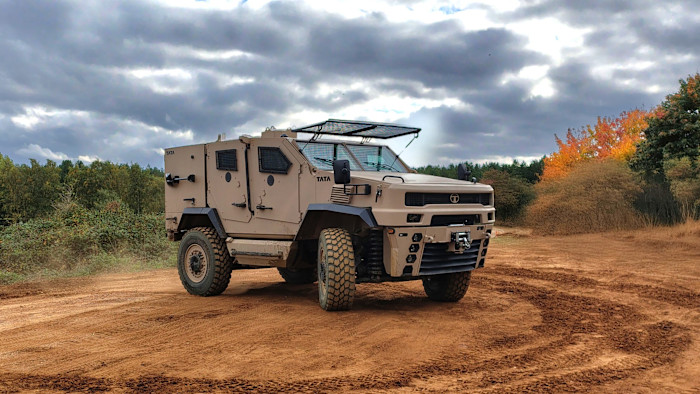
Tata Sons’ defence division is in talks to supply military hardware to African and European nations, as India pushes to strengthen its arms industry and expand exports.
India’s largest conglomerate is making its overseas push as Prime Minister Narendra Modi has vowed to build a “self-reliant India” by reducing the country’s dependence on imports and increasing its exports.
In September, Tata opened a factory near Casablanca to produce about 150 wheeled armoured platform vehicles for the Moroccan government. The factory is India’s first defence plant operated overseas by a private company, according to Tata.
“All platforms are already being proposed to countries abroad,” said Sukaran Singh, chief executive and managing director of Tata Advanced Systems, which manufactures equipment ranging from artillery to combat and logistics vehicles.
“We are in deep discussions,” Singh told the FT, describing the Morocco factory as an “entry point into Africa”.
Bordered by hostile China and Pakistan, India is one of the world’s largest arms importers. New Delhi has increasingly been buying weapons from the US, France and Israel as it seeks to retool its military, which has historically relied on Russia.
“Pretty much every country wants to diversify away from their current set” of suppliers, said Singh. “In some cases it’s the US, Russia, in some cases it’s China, Turkey, Israel, they are the big suppliers to different countries.”
To build a “self-reliant India”, Modi has opened up the defence industry to the private sector since taking power in 2014. State-owned defence companies still account for 77 per cent of Indian arms production, despite being constrained by capacity limits and order backlogs, according to India’s defence ministry.
Modi’s government has set an annual defence production target of $33bn with $5.6bn of exports by 2029, up from $14bn in total arms manufacturing and $2.6bn of exports in 2024.
Tata is among the leading private Indian companies, along with the Adani Group, Bharat Forge and Larsen & Toubro, that have a burgeoning military hardware portfolio.
Singh said rising geopolitical tensions, including conflict with Pakistan and souring US relations, highlighted the need for a more self-sufficient military-industrial base.
“It has become a real risk mitigation issue,” said Singh. “You must have your own core — that is a national imperative.”
In recent years, New Delhi has reserved nearly three-quarters of its defence modernisation budget for domestic manufacturers. It has pushed foreign arms groups to partner with local companies for joint production or technology transfer, and directed India’s Defence Research and Development Organisation to share patented tech with the private sector.
“India needs its own R&D, its own platforms and its own control. That actually is, in my opinion, not happening enough,” said Singh. “The government itself is saying the private sector needs to step up.”
Singh said Tata was adopting a “dual strategy” of building its own defence tech and serving as a contract manufacturer for global aerospace and arms companies in India. For example, the company makes military transport aircraft for Airbus and helicopter fuselages for Boeing.
Exports account for up to 45 per cent of privately held Tata Advanced Systems’ annual revenues, which have grown more than threefold since 2020 to Rs52bn ($570mn).
“It is large companies like us that can diversify and have a footprint abroad, as well as in India,” he added. “What is required is risk appetite.”
Other Indian conglomerates have similar ambitions. Steel magnate Sajjan Jindal, whose JSW Group is producing military vehicles and drones, told the FT in October “defence is one area which we are trying to pursue in a stronger way”. However, he cautioned that the sector remained relatively small.
Since 2000, India has bought nearly 10 per cent of all global weaponry, representing imports worth $62.2bn, while its defence exports stood at just $734mn, according to the Stockholm International Peace Research Institute, which tracks the global arms market.
Modi said domestic-made weapons played a key role during a four-day conflict with Pakistan last year and claimed the hostilities resulted in rising international interest in Indian arms.
Singh said Tata’s drones were “very much involved, as I’m told”, as were its ground vehicles. Tata has supplied more than 170,000 vehicles to various militaries and police forces.
In November, enthusiasm over the country’s military tech was damped by the crash of a Tejas fighter jet developed by India’s state-owned Hindustan Aeronautics at the Dubai Airshow. An Indian Air Force pilot died in the accident.
Singh said the accident was “highly unfortunate”, but it would not affect the growth of Indian defence manufacturers.
