


November 25, 2025
3 min read
This Fossil Is Rewriting the Story of How Plants Spread across the Planet
An enigmatic group of fossil organisms has finally been identified—and is changing the story of how plants took root on land
An artistic reconstruction of Spongiophyton during the Early Devonian in the Paraná Basin in present-day Brazil.
J. Lacerda/Bruno Becker-Kerber et al., “The rise of lichens during the colonization of terrestrial environments,” in Science Advances, Vol. 11, No. 44; October 29, 2025
Around 410 million years ago, terrestrial life was relatively simple. There were no forests or prairies—land was largely dominated by slimy microbial mats. The types of plants that would eventually give rise to trees and flowers had only just evolved and would take another several million years to fully flourish and diversify.
A new discovery is rewriting the story of how these vascular plants, as they are called, spread onto land. Researchers may have finally resolved a debate about an enigmatic but widespread fossil called Spongiophyton: it seems to have been a strange life-form called a lichen that may have helped pave the way for plants to thrive on land.
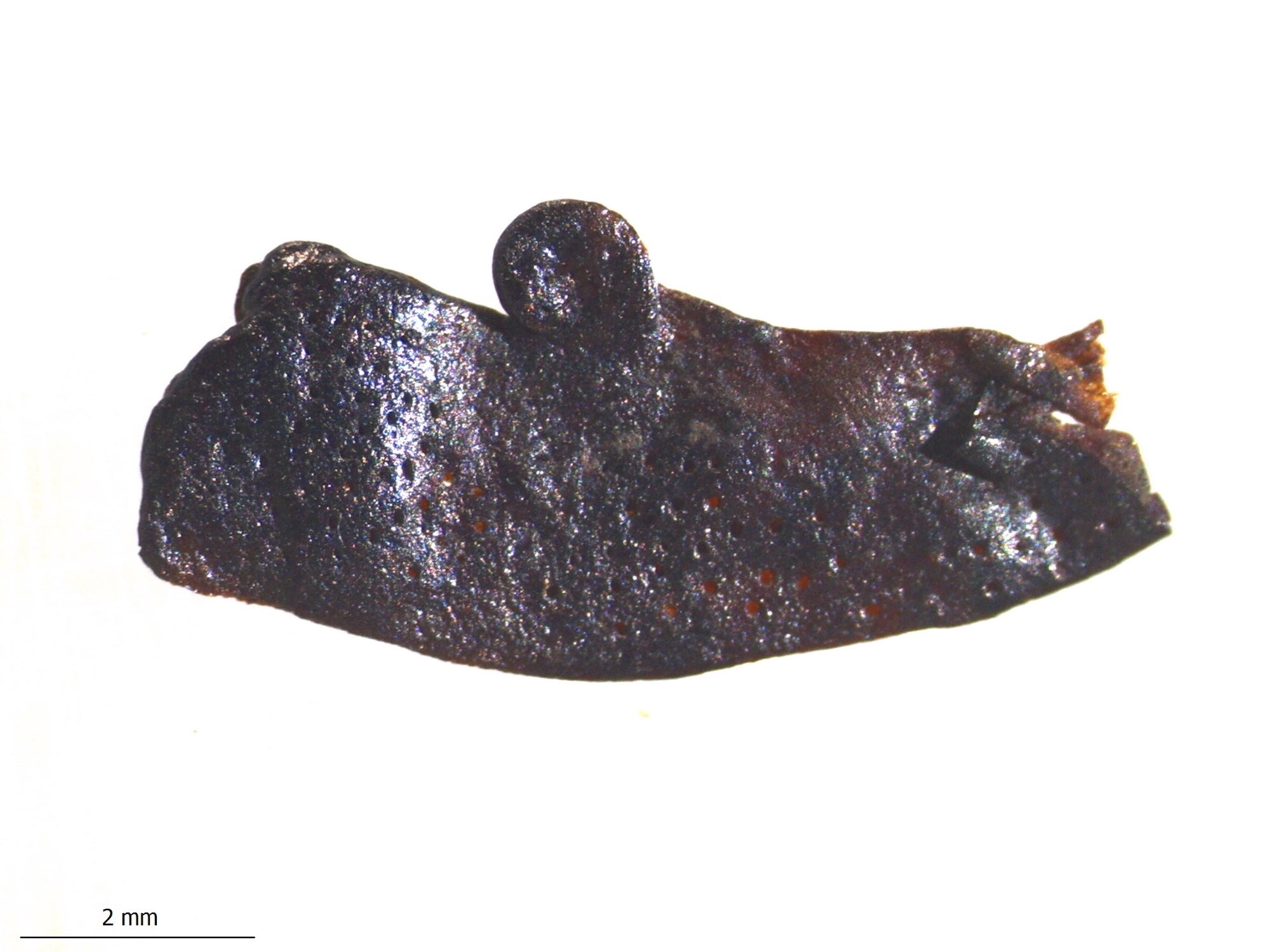
Fragment isolated from the stem of Spongiophyton nanum showing its upper surface with pores.
Bruno Becker-Kerber et al., “The rise of lichens during the colonization of terrestrial environments,” in Science Advances, Vol. 11, No. 44; October 29, 2025
On supporting science journalism
If you’re enjoying this article, consider supporting our award-winning journalism by subscribing. By purchasing a subscription you are helping to ensure the future of impactful stories about the discoveries and ideas shaping our world today.
The discovery, published recently in Science Advances, “settles a question that had been open for over a century,” says paleontologist Geovane Gaia, of the Institute of Geosciences at the State University of Campinas in Brazil, who was not involved with the research. “Until now, most people thought lichens appeared only after vascular plants, but this study shows they were already there at the beginning, literally helping prepare the ground for plant life.”
Lichens are the symbiotic result of fungi and photosynthetic algae or cyanobacteria working together. Today that amalgam helps churn lifeless rocks and sediments into nutrient-rich soil everywhere from polar deserts to tropical forests, says study lead author Bruno Becker-Kerber, a paleontologist at Harvard University. Vascular plants have tissues that funnel those soil nutrients from the ground to their stems and leaves.
Because lichens’ soft body tissues are rarely preserved in the fossil record, their origins have remained mysterious. A 2019 genetic analysis suggested they evolved well after the emergence of vascular plants, indicating they likely played little to no role in early land colonization.
Scientists have long debated whether Spongiophyton, which flourished around 410 million years ago, was lichen or algae. To determine the fossils’ identity, Becker-Kerber and his colleagues analyzed the underlying chemical properties of lingering organic material within the fossils.
Unlike algae, which are lined with cell walls, lichen contain fungi lined with chitin, the same material that makes up the exoskeletons of insects. Chitin is loaded with nitrogen, and the team’s results turned up an unmistakable nitrogen signal. “The more we tested it, the more consistent the signal became,” Becker-Kerber says. “It was genuinely exciting.”
There were other fungal traits present, too, such as a distinct branching pattern exhibited by growing fungal cells called hyphae. The results suggest lichen evolved around 410 million years ago, shortly after the initial spread of vascular plants 420 million years ago and just before the earliest known forests around 390 million years ago.
“It’s a major shift in how we view the complexity of life’s first steps onto land,” Becker-Kerber says. Spongiophyton “likely weathered rocks, stabilized sediments, cycled nutrients and contributed to the formation of protosoils just before forests developed.”
“If Spongiophyton was a lichen, it may have enabled the expansion of land plants into areas previously uncolonized,” says Matthew Nelsen, an evolutionary biologist at the Field Museum of Natural History, who was not involved with the research.
The new picture suggests lichen emerged near the beginning of terrestrial plant history and the unique fungi-algae relationship may have been essential to the spread of plants. “People often tell the story of life’s move onto land as a ‘plant story,’” Becker-Kerber says. “What our study shows is that fungi and lichens were also part of it.”
It’s Time to Stand Up for Science
If you enjoyed this article, I’d like to ask for your support. Scientific American has served as an advocate for science and industry for 180 years, and right now may be the most critical moment in that two-century history.
I’ve been a Scientific American subscriber since I was 12 years old, and it helped shape the way I look at the world. SciAm always educates and delights me, and inspires a sense of awe for our vast, beautiful universe. I hope it does that for you, too.
If you subscribe to Scientific American, you help ensure that our coverage is centered on meaningful research and discovery; that we have the resources to report on the decisions that threaten labs across the U.S.; and that we support both budding and working scientists at a time when the value of science itself too often goes unrecognized.
In return, you get essential news, captivating podcasts, brilliant infographics, can’t-miss newsletters, must-watch videos, challenging games, and the science world’s best writing and reporting. You can even gift someone a subscription.
There has never been a more important time for us to stand up and show why science matters. I hope you’ll support us in that mission.
