


Trump’s MRI Is Not Standard ‘Preventive’ Care, Say Experts
“It is certainly not standard medical practice to perform screening MRIs of the heart and abdomen,” says one expert
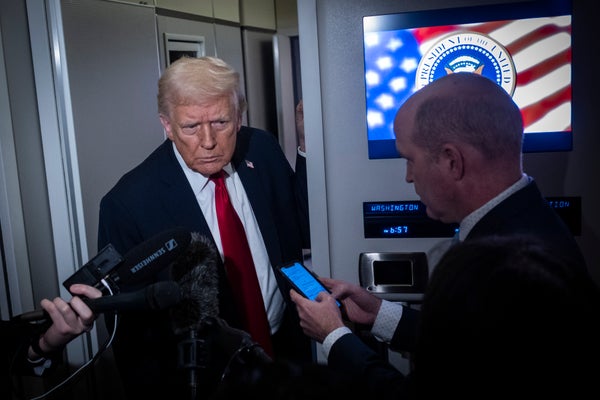
President Donald Trump speaks to the media aboard Air Force One on November 25, 2025.
Pete Marovich/Getty Images
Medical experts are questioning the White House’s explanation for President Donald Trump’s MRI tests as “preventive.”
A Monday memo released by presidential physician Sean Barbabella described the results of “a thorough evaluation of cardiovascular and abdominal health” as normal. “This level of detailed assessment is standard for an executive physical at President Trump’s age,” Barbabella said.
But imaging experts who spoke to Scientific American expressed doubts as to Barbabella’s assertion that magnetic resonance imaging (MRI) screening is typical preventive care. American Heart Association guidelines, for example, note that a cardiac MRI is usually requested because of existing heart conditions and often only after other tests.
On supporting science journalism
If you’re enjoying this article, consider supporting our award-winning journalism by subscribing. By purchasing a subscription you are helping to ensure the future of impactful stories about the discoveries and ideas shaping our world today.
“No, it is certainly not standard medical practice to perform screening MRIs of the heart and abdomen,” says radiologist and MRI expert Thomas Kwee of the University of Groningen in the Netherlands. Such imaging is typically only performed in the case of underlying disease, he says, or if there is suspicion of an underlying disease based on the patient’s medical history and physical examination. Barbabella’s memo said the imaging showed Trump was in “excellent health.”
Kwee’s comment echoed those of Medpage Today’s editor in chief, physician Jeremy Faust, who told CNN on Monday that “there’s really no such thing as routine prevention using an MRI.” Faust on Tuesday told Scientific American that the White House memo reference to “advanced imaging” left open questions as to exactly what tests Trump underwent. It could even possibly refer to a CT scan, for example, which is different than MRI. “If we knew exactly what imaging he received, it would give us a better idea of what conditions they are worried about,” Faust says.
In response to a request for comment, White House press secretary Karoline Leavitt pushed back on questions about what kind of scans Trump received and why, saying, “As the President’s physician, Dr. Sean Barbabella, has made clear time and again—and as the American people see with their own eyes every single day—President Trump remains in excellent overall health.”
There are commercial companies that offer “preventive” MRI screenings for a fee, with many marketed toward executives. Some hospitals also offer these kinds of health screenings, but a 2019 study published in JAMA on executive screening packages in 29 top-ranked hospitals found that none included MRIs.
“An assessment of a heart MRI and abdominal MRI is not ‘standard for an executive physical,’” says former White House physician Jeffrey Kuhlman, author of the book Transforming Presidential Healthcare. Though it’s not uncommon for physicians who have concierge-type practices to use total or partial body scans on their clients, “this is not evidence-based,” he adds.
Barbabella’s memo was released about a month after Trump disclosed to reporters on Air Force One that he had the imaging tests done. Trump said on Sunday that he had “no idea” what part of his body was imaged.
Questions around Trump’s health have surfaced repeatedly in recent months. In July the White House reported that the president has chronic venous insufficiency, a blood vessel disease that affects circulation and can cause ankle swelling. And noticeable bruises on the back of Trump’s hands seen in February were attributed to “shaking hands all day” by Leavitt.
There is no solid evidence that executive MRI scans help people, Kwee says, either by diagnosing disease or extending their lifespan. “These scans can also lead to unexpected incidental findings and give false reassurance that there is no underlying disease.”
It’s Time to Stand Up for Science
If you enjoyed this article, I’d like to ask for your support. Scientific American has served as an advocate for science and industry for 180 years, and right now may be the most critical moment in that two-century history.
I’ve been a Scientific American subscriber since I was 12 years old, and it helped shape the way I look at the world. SciAm always educates and delights me, and inspires a sense of awe for our vast, beautiful universe. I hope it does that for you, too.
If you subscribe to Scientific American, you help ensure that our coverage is centered on meaningful research and discovery; that we have the resources to report on the decisions that threaten labs across the U.S.; and that we support both budding and working scientists at a time when the value of science itself too often goes unrecognized.
In return, you get essential news, captivating podcasts, brilliant infographics, can’t-miss newsletters, must-watch videos, challenging games, and the science world’s best writing and reporting. You can even gift someone a subscription.
There has never been a more important time for us to stand up and show why science matters. I hope you’ll support us in that mission.
