

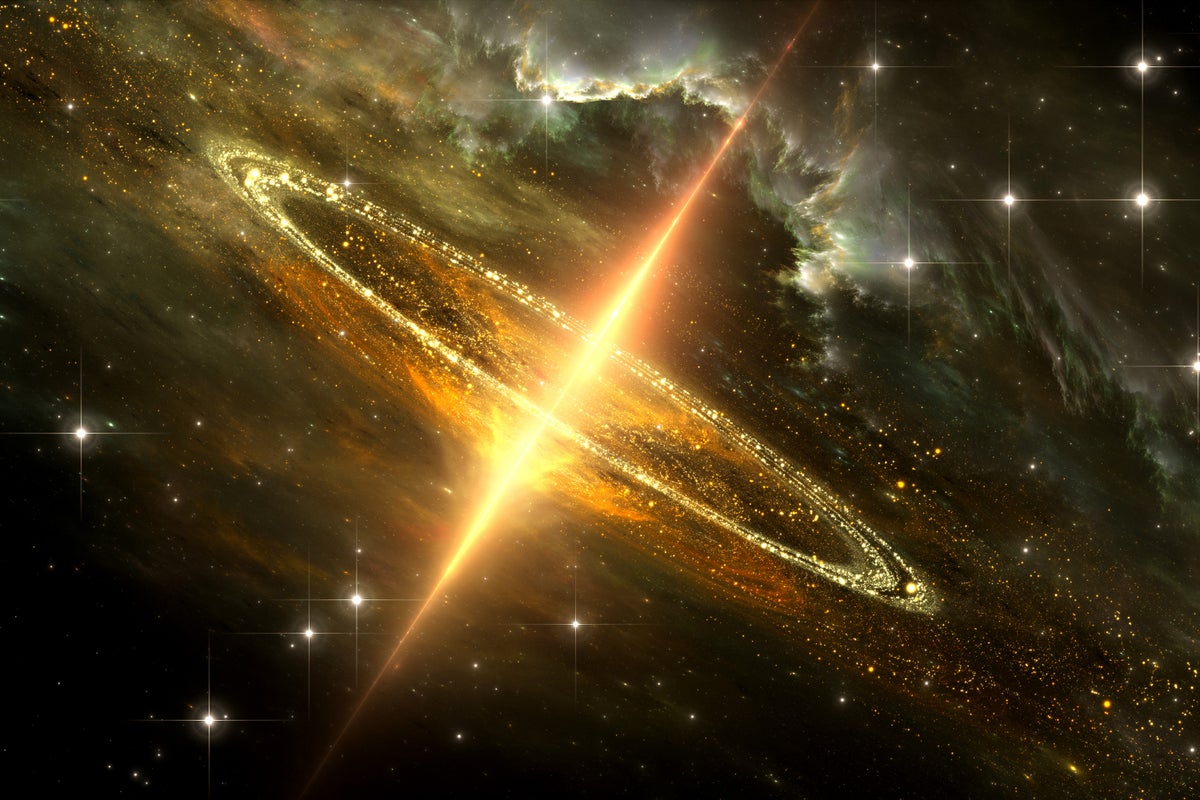
In the early 1960s astronomers discovered a monster.
Something in the constellation of Virgo was pouring out radio waves, but no counterpart in visible light was initially seen. That changed when observers used some clever techniques to glimpse a faint blue “star” sitting at the radio source’s exact position. Eventually they were able to determine that this object, called 3C 273, was not a star at all but rather something much stranger located a staggering two billion light-years from Earth.
To be visible at all across such vast stretches of space, the “quasi-stellar object” (quasar for short) 3C 273 had to be overwhelmingly bright. Scientists ultimately settled on a feeding black hole at the heart of a far-distant galaxy as the most likely engine for 3C 273’s ridiculous luminosity. And this wasn’t just any black hole but a positively Brobdingnagian one, likely containing 900 million times the mass of our sun.
On supporting science journalism
If you’re enjoying this article, consider supporting our award-winning journalism by subscribing. By purchasing a subscription you are helping to ensure the future of impactful stories about the discoveries and ideas shaping our world today.
Since that time we’ve found many more such supermassive black holes. In fact, by the 1980s astronomers were starting to suspect that every big galaxy had a supermassive black hole in its center. Thanks to observations from the Hubble Space Telescope and other facilities, we now know that to be true—which means there could be as many as a trillion such giants in the observable universe.
And they can get massive—very, very massive. Many have been found with a billion times the sun’s mass, and the beefiest can be even higher than that.
This naturally raises the question: Just how big can one get?
Answering it, however, gets a bit tricky. A notional upper limit could pop out of mass measurements for many black holes, but such observations are difficult and often rely on indirect evidence and incomplete accounting of all the physics involved. With that in mind, though, this approach suggests that the biggest black holes top out around a few tens of billions of solar masses—that’s as hefty as a smallish galaxy! Only a handful of these ultraheavyweights are known, and the uncertainties in their masses can be quite large.
Still, is it possible that some could be even bigger? After all, in principle, a black hole could grow without end because these objects gain mass by eating anything and everything that gets too close; if you could somehow offer up the entire universe as a meal, a black hole would happily consume it.
But piling the whole cosmos on a black hole’s dinner plate isn’t very realistic, of course. According to research published in the Monthly Notices of the Royal Astronomical Society: Letters in 2015, under physically possible (but implausibly ideal) conditions, the theoretical upper limit for a feeding, growing black hole should be a whopping 270 billion solar masses! More likely, though, the largest we’ll ever find will be closer to a mere 50 billion or so.
The discrepancy boils down to just how close an object must get to a black hole to be pulled in. Even the largest black holes are only a few tens of billions of kilometers across—on a similar scale to the size of our solar system—which is tiny on the cosmic stage. From a distance, you’re perfectly safe from their gravity. If a solar-mass black hole suddenly replaced our sun, we’d have fatal problems—such as freezing to death—but our falling in wouldn’t be one of them; Earth and the other planets would continue in their orbits as if nothing changed. Similarly, our Milky Way galaxy has a central supermassive black hole called Sgr A* (pronounced “Sagittarius A star”) that’s about four million solar masses. It’s some 26,000 light-years away from us, but it causes us no distress at all.
This really means that it’s rather rare for anything to fall into a black hole—and even when it happens, the mechanics aren’t straightforward. Most material won’t plunge headlong into the cosmic dumpster’s maw. Instead its orbital speed increases as it falls toward the black hole so that it whirls madly around the compact object. This captive matter will form a flattened disk called an accretion disk.
Within the disk, material closer in will orbit faster than matter farther out. This generates incredible friction, heating the disk to millions of degrees. Matter that hot glows fiercely, which is one way we can detect black holes in the first place: although they’re invisible, the effect they have on nearby material can be seen, even clear across the universe, as with 3C 273.
The disk can be so hot that material within it can actually be blown away by the intense radiation. Disks can have powerful magnetic fields that can also draw matter away. Together these effects limit how rapidly a black hole can feed: a glut of infalling material can cause the disk to get so big and hot that it repels any additional approaching matter. This is called the Eddington limit; think of it as how rapidly a black hole can eat without—and pardon the indelicacy, but an analogy is an analogy—vomiting it back out.
So it takes time for a black hole to grow. And time is limited: the universe had a finite beginning. At best a black hole has had 13.8 billion years—the age of the cosmos—to stuff itself—and the earliest evidence we’ve found for black holes dates to a few hundred million years after that time, further limiting their cosmic feeding frenzy.
Factoring in these temporal limitations, the biggest black hole today should be no larger than 270 billion times the mass of the sun. And that’s only if all its feedstock is revolving in the same direction as the black hole’s spin, which acts as a digestive aid, allowing material to fall in more rapidly. If the black hole doesn’t spin, or the material falls in the opposite direction to that spin, the upper limit falls to the 50 billion solar mass figure.
That smaller number is indeed in the ballpark of the highest-mass black holes we’ve detected. Some, like one called TON 618, appear to be a bit bigger, but there is a lot of uncertainty in that number, and the lower limit is probably a little fungible as well.
I hasten to add that despite all this detailed discussion of how black holes dine on matter, they can also grow a different way, via cosmic cannibalism: when galaxies collide, their individual supermassive black holes can eventually fall together and merge to become a single, even bigger black hole. That’s a time-saver! But really huge black holes are so rare—never mind the even rarer prospect of their merging—that it’s unlikely this would significantly expand the boundaries on black-hole growth.
So we don’t expect to find one any bigger than those we’ve already managed to measure. But the universe is smarter than we are, and it’s still possible an even more colossal black hole might exist. If so, that’ll give astronomers a chance to do their favorite thing: go back to their assumptions and try to figure out what they missed, learning more about these behemoths in the process. In that way, our knowledge grows, and, hopefully, there’s no upper limit to that.
