
|
The presidential oath of office requires the president to “faithfully execute the Office of President” and to “preserve, protect and defend the Constitution of the United States.” This oath binds the president to a system of limited powers, separation of powers, and checks and balances. By declaring, “I have the right to do anything I want to do. I’m the president of the United States,” Trump rejected the very premise of constitutional government: that no one, not even the president, is above the law. Such a claim contradicts his duty of faithful execution, which obligates him to enforce laws as written by Congress and constrained by the Constitution. In effect, Trump’s statement is an assertion of absolute power, more in line with monarchy or dictatorship than with the constitutional presidency he swore to uphold. It violates the oath because it denies the limits that define the office itself, replacing fidelity to the Constitution with personal will. By claiming unchecked authority, he positioned himself outside the very framework that legitimizes his power, which is a fundamental breach of the oath of office. |
Trending
- NASA Announces Artemis III Crew
- Dive Into a Very Noisy Sea With Some Very Rare Whales
- Crowds Flood New York City Streets for First Day of Manhattanhenge
- Blue Origin Rocket Explodes on Florida Launchpad
- Fireball Falls From Space Over Erupting Volcano in the Philippines
- Inside the Interstitium, the Human Body’s Hidden Pathways
- Pentagon Releases U.F.O. Files – The New York Times
- How Iran Accumulated 11 Tons of Enriched Uranium
Trump violating his oath of office (again): “I have the right to do anything I want to do. I’m the president of the United States.”
 By
By 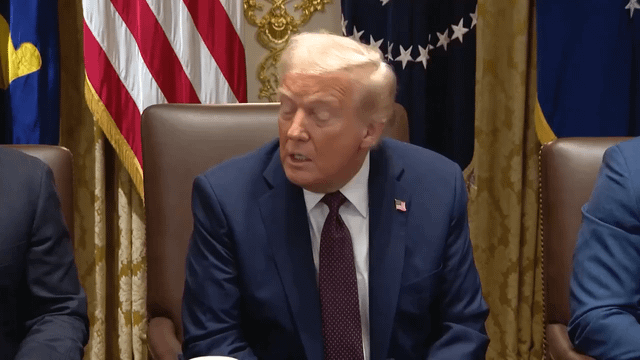

Add A Comment